Quick answer: Patal Bhuvaneshwar is a limestone cave temple of Lord Shiva at about 1,350 m in Pithoragarh district, Uttarakhand, 14 km from Gangolihat. A narrow, steep passage with iron chains leads about 90 feet down into a cave roughly 160 m long, where natural rock forms are worshipped as Sheshnag, Ganesh, Shiva’s jata and many deities. Allow an hour inside. It is about 91 km from Pithoragarh and 113 km from Almora.
Updated for the 2027 yatra season (facts checked November 2026).
Few temples in the Himalaya feel like Patal Bhuvaneshwar. You leave daylight behind, climb down a slippery shaft holding a chain, and arrive in a chamber where the priest’s lamp picks out shapes in the rock that devotees have worshipped for centuries. For many yatris it is the most memorable stop in Kumaon.
This guide explains what is inside according to tradition, how the descent works and who should think twice, current rules, distances from the main Kumaon towns, the best months, and how the cave fits into an Adi Kailash or Kumaon temple yatra. Rules and timings change, so please check locally before you go.
Where is Patal Bhuvaneshwar?
The cave is in Bhubaneshwar village, near Gangolihat in the Berinag–Gangolihat area of Pithoragarh district, Kumaon. It sits at about 1,350 m above sea level on a ridge between the Saryu and Ramganga valleys, with deodar and oak forest around it. A paved path of a few hundred metres leads downhill from the parking area to the cave mouth.
The name means “Bhuvaneshwar of the underworld (Patal)”. Devotees regard the cave as a sacred world beneath the earth where all the gods reside.
What is inside Patal Bhuvaneshwar cave?
The cave was formed by water flowing through limestone over a very long time, leaving stalactites, stalagmites and chambers within chambers. The priests, from families who have served here for generations, lead small groups through and explain each formation. The following are described in local tradition and by the priests; they are matters of faith, explained as they are told at the cave.
- Sheshnag: near the entrance, a rock form seen as the serpent Sheshnag, with ribs along the ceiling, believed to hold up the earth.
- Adi Ganesh: a form linked with the story of Lord Ganesh’s head, with water dripping onto it from a formation seen as a Brahmakamal.
- Shiva’s jata: a formation seen as the matted locks of Lord Shiva, with water dripping below, near the place where the 33 koti devtas are said to reside.
- The Char Dham in miniature: forms identified with Kedarnath, Badrinath and Amarnath, which is why devotees say darshan here carries the merit of many tirthas.
- The four doors: four openings called Paap Dwar, Ran Dwar, Dharm Dwar and Moksh Dwar. The priests explain which are believed to have closed in earlier ages and which remain open.
- Airavat: marks on the ceiling identified with Indra’s elephant Airavat, along with other forms the priests point out along the way.
- A growing linga: a formation believed to be slowly rising; tradition says the age will end when it touches the ceiling.
- Shiva–Shakti linga: at the deepest point usually visited, where the priest performs a short puja.
Local belief also holds that passages from the cave lead to Kailash, Kashi and other tirthas. These are not open to anyone.
What is the history and legend of the cave?
The cave is described in the Manas Khand of the Skanda Purana. Tradition says it was first found in the Treta Yuga by King Rituparna of the Suryavansh, who followed a deer into the forest and was guided inside by Sheshnag, where he had darshan of the gods including Lord Shiva. The Pandavas are said to have meditated here, and the cave is believed to have been closed for ages and revealed again in the Kali Yuga by Adi Shankaracharya.
Today the cave is looked after by the hereditary priest families and the temple committee, and photography inside is controlled (see the rules below).
How does the descent work, and who should avoid it?
This is the most important section for families. The entry is not a staircase into a hall.
- Walk down to the cave mouth: a short paved downhill path from the parking area. You will walk back up it at the end.
- Leave belongings: shoes, phones, cameras and bags are deposited before entry.
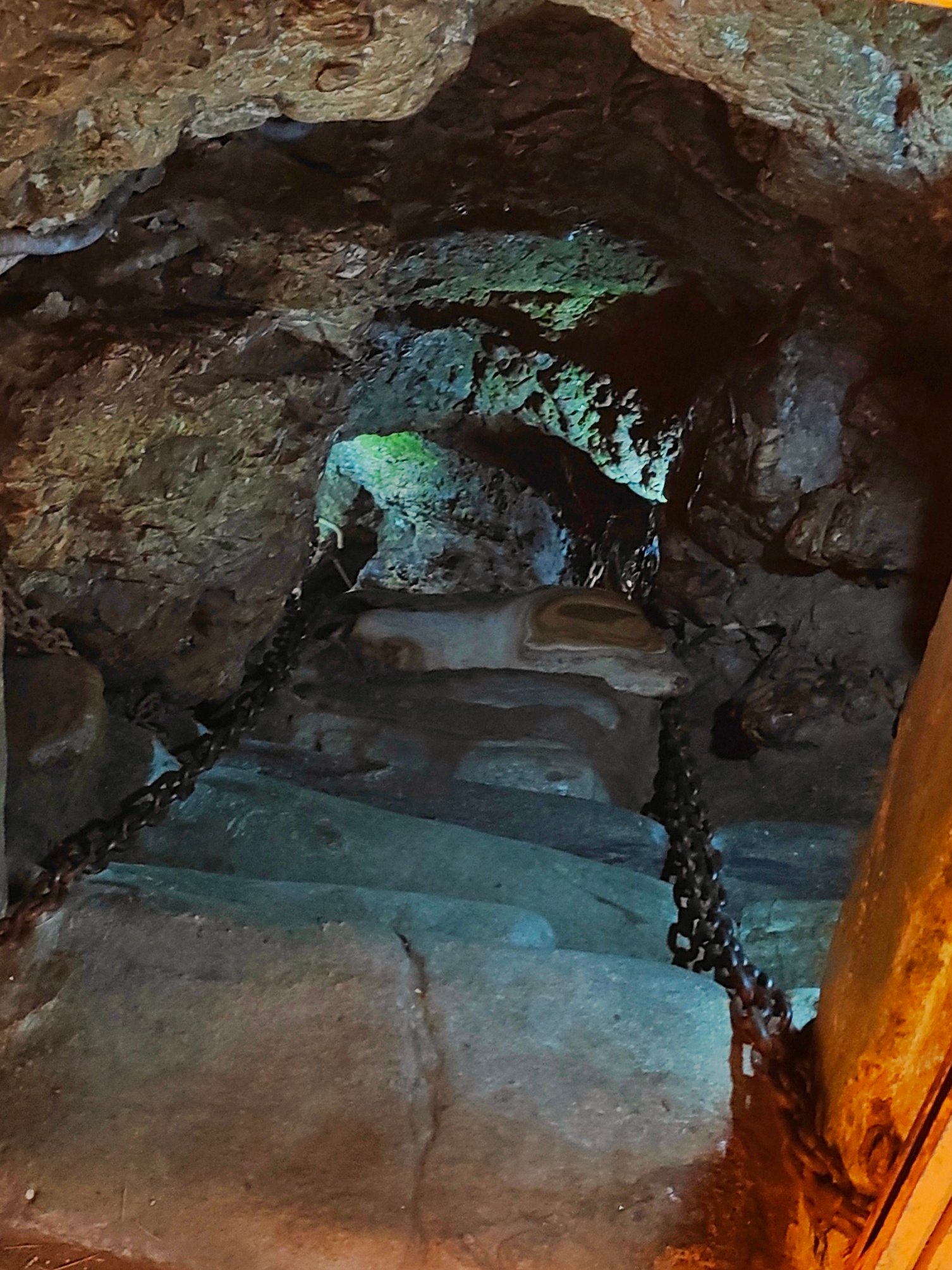
- The shaft: a narrow, low opening leads into a steep, slippery rock passage. You crouch and climb down backwards or sideways, holding iron chains fixed to the rock. In places only one person fits at a time.
- The cave floor: about 90 feet below the entrance, the cave opens up and is lit by electric lights. The floor is uneven and wet in places.
- The darshan walk: the priest takes the group through the formations in about 45 minutes to an hour.
- The climb out: back up the same chained passage, which is harder than coming down.
Think carefully if you have: claustrophobia, serious knee, hip or back problems, heart or breathing conditions, or very limited mobility. Air inside the cave is still and can feel heavy, and the temple committee has said oxygen levels fall in the monsoon. Pregnant women and small children should not attempt it.
Many families have one or two members wait at the top, where there is a small temple area to sit. There is no shame in this; darshan is complete through the sankalp of the family.
What are the timings and rules?
| Item | What to expect (confirm locally) |
|---|---|
| Timings | Daylight hours; about 9 am to 5 pm is commonly reported. Groups go in batches, so the last entry is earlier than closing. |
| Monsoon closure | In 2025 the temple committee closed the cave from 11 August to 10 October for safety and reopened it on 12 October. Check whether a similar closure applies in 2027. |
| Ticket | An entry ticket is charged at the counter; there is a separate offering for the priest’s puja if you wish. |
| Phones and cameras | Not allowed inside; deposit them before entry. Photography inside is not permitted without official permission. |
| Footwear | Removed before entry. Woollen socks help on the cold, wet floor. |
| Group size | Small batches with a priest-guide, because space and air are limited. |
| Time needed | About 1 hour inside; 1.5–2 hours including the walk and waiting. |
What to wear: loose, comfortable clothes you do not mind getting dirty; trousers are better than sarees for the descent. A light layer helps, as the cave is cool.
How to reach Patal Bhuvaneshwar
There is no railway or regular airport close by; the last stretch is always by road.
- By rail: Kathgodam (for Haldwani) is the nearest major railhead, with trains from Delhi and Dehradun. From there it is a full day’s drive via Almora.
- By air: Pantnagar airport, in the plains near Rudrapur, has flights from Delhi; check current schedules. Naini Saini airport at Pithoragarh, about 90 km away, has small-aircraft and regional services that change often; check before planning around it.
- By road: buses and taxis run from Haldwani, Almora and Pithoragarh to Gangolihat or Berinag, and local taxis cover the last 14 km. Our own vehicle is the comfortable option for families.
What is the distance to Patal Bhuvaneshwar from nearby towns?
Hill roads are slow, and distances vary with the route taken. These are approximate road figures from district and travel sources.
| From | Approx. distance | Approx. drive time |
|---|---|---|
| Gangolihat | 14 km | 30–40 minutes |
| Chaukori | About 37 km | 1.5–2 hours |
| Pithoragarh | About 91 km | 3 hours |
| Jageshwar | About 105 km | 3.5–4 hours |
| Almora | About 113 km | 4–5 hours |
| Kathgodam / Haldwani | About 180–210 km (longer by some routes) | 6–8 hours |
From Dehradun or Delhi, plan at least two days of road travel, with a night at Bhimtal, Almora or Chaukori on the way. For senior citizens we suggest never doing Kathgodam to Patal Bhuvaneshwar and back in one day.
When is the best time to visit Patal Bhuvaneshwar?
- March to June: pleasant weather and the most comfortable time for the cave and the drive.
- Late September/October to November: clear skies, Himalayan views from Chaukori and Gangolihat, and dry paths. Check that the cave has reopened after the monsoon.
- July to September: monsoon. Roads see landslides, the passage is slippery and the cave may be closed.
- December to February: cold, with occasional snow on the higher roads, but the cave itself can be visited when roads are open.
Mahashivratri and the Shravan month draw local crowds, so expect longer waits on those days.
How does Patal Bhuvaneshwar fit into an Adi Kailash or Kumaon yatra?
Patal Bhuvaneshwar lies close to the main road between the Almora side of Kumaon and Pithoragarh–Dharchula, the gateway for Adi Kailash and Om Parvat. That makes it a natural stop on the way up or down. Our eight-day Adi Kailash and Om Parvat Yatra from Delhi visits Kainchi Dham, Chitai Golu Devta and Jageshwar on the way up, and Patal Bhuvaneshwar on the way down, with a night at Didihat or Chaukori before it.
A Kumaon temple circuit usually links:
- Kainchi Dham of Neem Karoli Baba, near Bhowali
- Chitai Golu Devta temple near Almora
- Jageshwar Dham, the ancient temple group in deodar forest
- Patal Bhuvaneshwar and Haat Kalika at Gangolihat
- Onward to Pithoragarh and Dharchula for Adi Kailash, or back to Kathgodam
For the permit and road details beyond Dharchula, read how to reach Adi Kailash, or see all our Adi Kailash yatras. Hindi readers can see our Adi Kailash yatra page in Hindi.
What is Haat Kalika temple at Gangolihat?
Haat Kalika, in a deodar grove at Gangolihat, roughly 14 km from the cave by road, is one of the most revered Devi temples of Kumaon. Mahakali is worshipped here, and tradition holds that Adi Shankaracharya established the shrine as a Shakti Peeth. The Kumaon Regiment of the Indian Army honours Haat Kalika as its presiding goddess, and soldiers and their families come here to offer thanks. Most yatris visit Haat Kalika and Patal Bhuvaneshwar on the same day.
What we arrange
Our team includes Patal Bhuvaneshwar on Kumaon and Adi Kailash yatras with our own vehicle and driver, a night halt nearby so the cave is visited in the morning, and a plan for any family members who prefer to wait at the top. Our three-day Kumaon Yatra covers Jageshwar and Golu Devta, and we can extend it to Patal Bhuvaneshwar on request. For a plan for your family, use the enquiry form on this page or call/WhatsApp us (numbers on our Contact page).
Frequently asked questions
Where is Patal Bhuvaneshwar cave located?
Patal Bhuvaneshwar is in Bhubaneshwar village near Gangolihat, in Pithoragarh district of Kumaon, Uttarakhand, at about 1,350 m. It is 14 km from Gangolihat, about 91 km from Pithoragarh and about 113 km from Almora. The nearest major railway station is Kathgodam, a full day’s drive away via Almora.
How deep is Patal Bhuvaneshwar cave?
The cave is commonly described as about 160 m long and around 90 feet below the entrance. You reach the floor through a narrow, steep passage, holding iron chains fixed into the rock. Once inside, the cave opens into several lit chambers, and the priest-guide leads the group through the main formations in about an hour.
Is Patal Bhuvaneshwar suitable for senior citizens?
It depends on fitness. The entry passage is narrow, steep and slippery, and the climb out is harder than the descent. Elders with knee, hip, back, heart or breathing problems, and anyone with claustrophobia, should not attempt it. Fit seniors manage with care and help. Family members who stay out can wait at the top.
Is photography allowed inside Patal Bhuvaneshwar?
No. Phones and cameras must be deposited before you enter, and photography inside is not permitted without official permission. This protects the formations and keeps the narrow passage clear. Check the current rule at the ticket counter, as arrangements can change, and keep your phone in the vehicle or locker.
What are the timings of Patal Bhuvaneshwar?
The cave is open in daylight hours, commonly reported as about 9 am to 5 pm, with groups entering in batches, so the last entry is earlier than closing. It may close during the monsoon: in 2025 it was shut from 11 August to 10 October for safety. Confirm the timings and any closure locally before you travel.
How far is Patal Bhuvaneshwar from Jageshwar and Almora?
Patal Bhuvaneshwar is about 105 km from Jageshwar, roughly three and a half to four hours by road, and about 113 km from Almora, roughly four to five hours. Many yatris visit Jageshwar one day, stay at Chaukori or Gangolihat, and see the cave and Haat Kalika the next morning.
Can I visit Patal Bhuvaneshwar on the way to Adi Kailash?
Yes. The cave lies near the road between Almora and Pithoragarh, the route to Dharchula and Adi Kailash. Most plans visit it on the way back, when yatris are acclimatised and less rushed. Our Adi Kailash and Om Parvat Yatra from Delhi includes it on the return, with a night at Didihat or Chaukori before the visit.
How long does the Patal Bhuvaneshwar darshan take?
Plan about one hour inside the cave, and one and a half to two hours in all, including the walk from the parking area, depositing belongings and waiting for your batch. On Mahashivratri, Shravan and holiday weekends the wait can be longer, so go early in the morning.