Quick answer: Mount Kailash has four faces, one towards each direction. The south face, with its vertical groove and rock bands, is seen from Darchen, Yam Dwar and Mansarovar. The west face appears on Day 1 of the parikrama, the dark north face rises above Dirapuk, and the east face is glimpsed briefly after Dolma La. Tradition links each face with a sacred river and a precious substance, though accounts differ.
Updated for the 2027 yatra season (facts checked October 2026)
Most people know Kailash from one photograph: a snow-capped dome with a long vertical line down its middle. That is only one side of the mountain. On the yatra, and especially on the three-day parikrama, you see Kailash change shape and mood as you walk around it. Knowing which face you are looking at, and what tradition says about it, makes each darshan richer. This guide explains all four, where to see them, and when the light is best.
What are the four faces of Mount Kailash?
Kailash stands almost alone, with ridges falling away on each side, so it presents four broad faces to the four directions. The parikrama, walked clockwise by Hindus, Buddhists and Jains, passes all of them:
- South face: the familiar face, seen from the plain and the lake.
- West face: seen across the Lha Chu valley on the first day of the parikrama.
- North face: the sheer, dark wall above Dirapuk, considered by many the most powerful darshan.
- East face: the least seen, visible only briefly on the second day.
What does tradition say about each face?
Hindu and Tibetan traditions both describe Kailash, or the cosmic Mount Meru with which it is identified, as having four sides of different precious substances. The Vishnu Purana names crystal, ruby, gold and lapis lazuli. Which substance belongs to which side is not agreed. In popular Indian accounts the south face is often called sapphire or lapis, the east crystal, the west ruby and the north gold. Some Tibetan Buddhist accounts, linking the faces to the four faces of the deity Chakrasamvara (Demchok), give a different set: east blue (lapis), north green (emerald), west red (ruby) and south yellow (gold).
The four great rivers of the region are also linked with the four directions. In commonly cited Tibetan accounts, each flows from the mouth of a sacred animal. Geographically, these rivers rise in the wider Kailash–Mansarovar region, not from the mountain itself, but the directional link is broadly accurate.
| Face | River traditionally linked | Tibetan name (sacred animal) | Precious substance (accounts differ) | Where you see it best |
|---|---|---|---|---|
| North | Indus (Sindhu) | Senge Khabab (lion) | Gold in popular Indian accounts; emerald in some Tibetan ones | Dirapuk, end of parikrama Day 1 |
| South | Karnali (Ghaghara) | Mapcha Khabab (peacock) | Sapphire or lapis in popular Indian accounts; gold in some Tibetan ones | Darchen, Yam Dwar, Ashtapad, Mansarovar shore |
| East | Brahmaputra (Yarlung Tsangpo) | Tamchok Khabab (horse) | Crystal in popular Indian accounts; lapis in some Tibetan ones | A side valley on the descent from Dolma La, Day 2 |
| West | Sutlej | Langchen Khabab (elephant) | Ruby in most accounts | Lha Chu valley, parikrama Day 1 |
Please read the substances as matters of faith and symbolism. We give the variations because you will hear different versions from different guides and books, and none of them is wrong within its own tradition.
Where is the south face of Kailash seen?
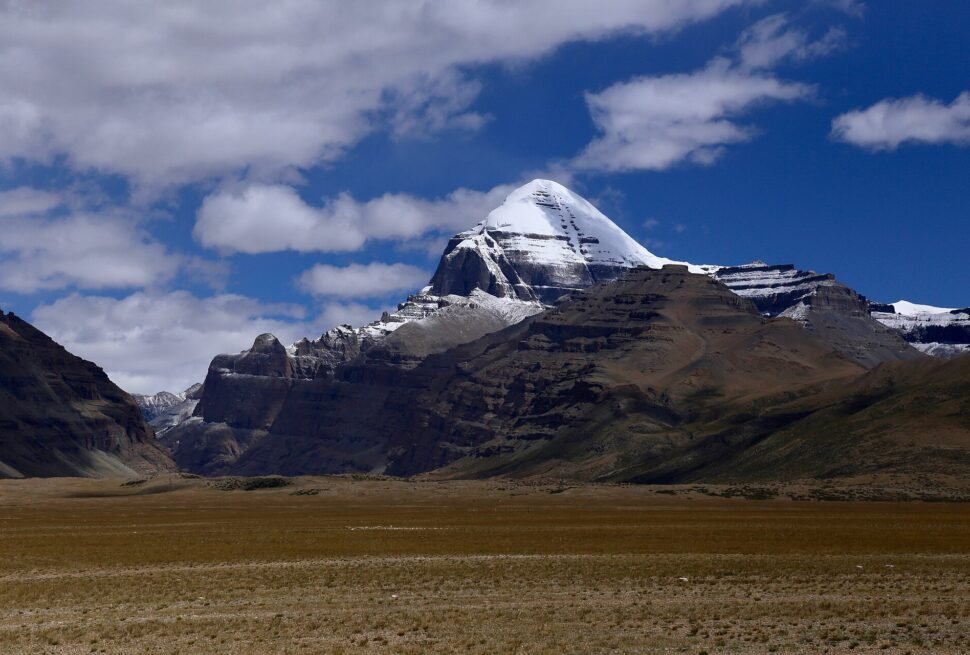
The south face is the one in most photographs. A deep vertical cleft runs down from the summit, crossed by horizontal bands of rock. Together they make a pattern that many devotees see as a swastika, the auspicious symbol shared by Hindu, Buddhist, Jain and Bon traditions. Below it sits the rounded peak known as Nandi, seen as Shiva’s vahan sitting before his Lord.
You see the south face from Darchen, the town at the foot of the mountain, from Yam Dwar (Tarboche) where the parikrama begins, and from a distance across Lake Mansarovar. When the authorities allow it, a short excursion from Darchen towards Ashtapad brings you much closer. The inner parikrama, behind Nandi towards the Saptarishi caves, goes closer still. See our Charan Sparsh and Ashtapad guide for how these work.
Where do you see the west face?
On Day 1 of the parikrama, after Yam Dwar, the path follows the Lha Chu river north through a wide valley of red cliffs. For much of the day the west face of Kailash is visible to the east of the path, above the valley wall. It is a long, more rounded profile than the south face, and changes as you walk. Many yatris find this quiet stretch, walking steadily with the mountain on their right, the best time for japa.
Why is the north face of Kailash so special?
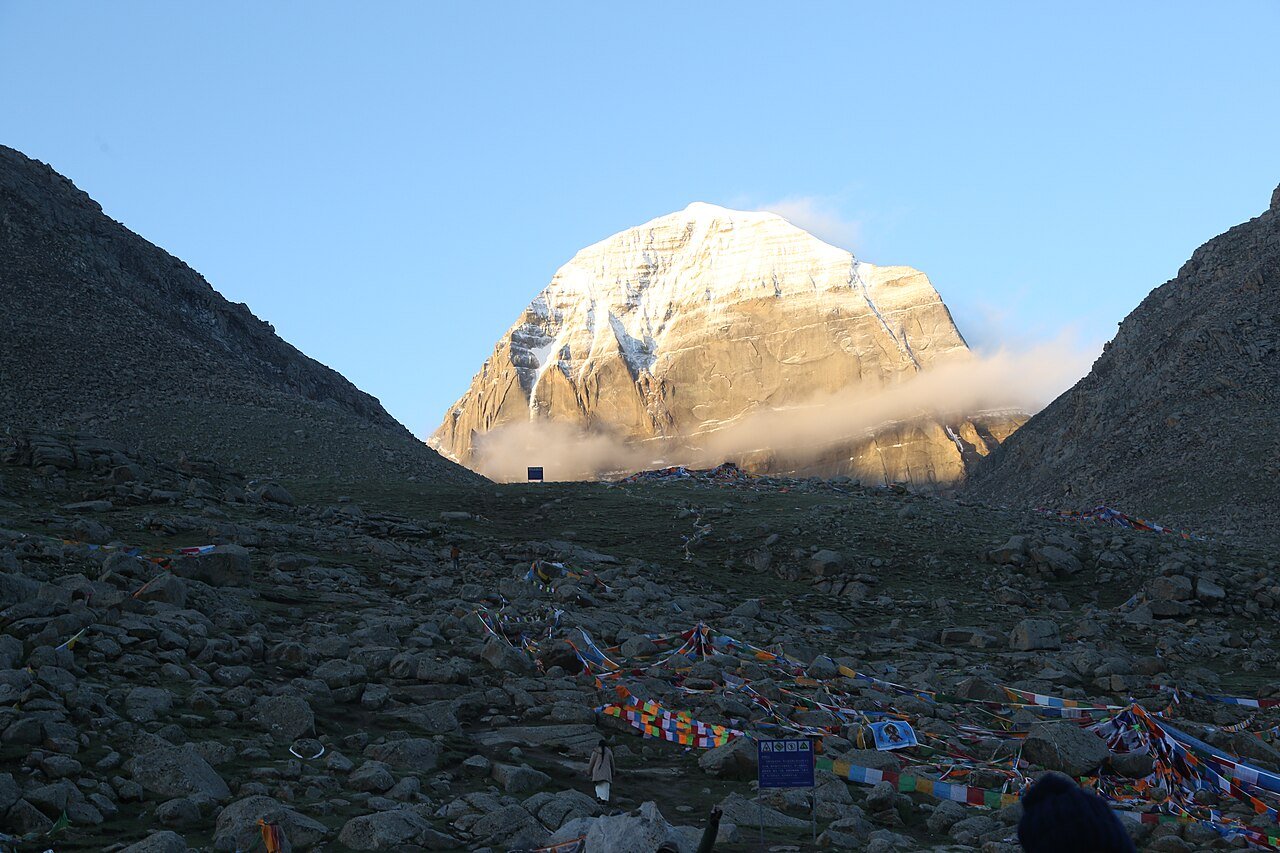
Near Dirapuk, the first night halt at about 4,900 m, the valley turns and the north face rises straight ahead: a sheer wall of dark rock streaked with snow, close enough to fill your view. The MEA’s yatra booklet singles out Dirapuk for the closest and clearest view of the mountain. For many yatris this is the moment the whole yatra has been leading to.
Many devotees say they can see the face of Shiva in the rock and snow patterns here, and some speak of seeing it on the south face too. That is a matter of devotion and perception, and you will hear it described in many ways. What everyone agrees on is the sense of presence.
The north face is also where the Charan Sparsh walk goes: from Dirapuk across the stream and up the moraine to the foot of the mountain. It needs an extra night, good acclimatisation and the guide’s judgement on the day, and access depends on the authorities each season. Our Kailash parikrama guide explains how it fits into the walk.
Can you see the east face of Kailash?
Only briefly. On Day 2 the parikrama climbs from Dirapuk to the Dolma La pass (about 5,630 m) and then descends steeply past Gauri Kund. On the way down towards the valley leading to Zuthulpuk, a side valley opens for a short time with a view of the east face. Many yatris are too tired by then to notice it, so ask your guide to point it out. The east face is never seen by those who do not walk the parikrama.
Which faces can you see without doing the parikrama?
If you are not walking, you will still have good darshan of the south face from Darchen, from Yam Dwar and from the Mansarovar shore. If permitted, the Ashtapad excursion gives a close view of the south face with only a short walk. The west, north and east faces are seen only on foot or pony along the parikrama. An aerial darshan flight from Nepal shows the mountain from the air, but which face you see depends on the flight path and weather on the day.
When is the best light for darshan of each face?
Weather decides more than anything else. In summer, clouds often build after midday, so mornings are generally clearer. These are general patterns, not guarantees:
- South face: lit by the sun for much of the day. Early to mid-morning from Darchen or Yam Dwar usually gives the clearest view, before afternoon cloud.
- West face: catches afternoon and evening light, which suits the timing of Day 1 as you walk towards Dirapuk.
- North face: in shadow for much of the day, but often described as most striking at first light and at sunset, when the summit glows gold. Step out of the guest house at dawn even if it is cold.
- East face: best in morning light, but you reach its viewpoint around midday on Day 2, so take whatever the sky gives.
June and September usually bring the clearest skies of the season. July and August overlap with the monsoon on the Indian side and can be cloudier.
What we arrange
Our Kailash Yatra by Helicopter from Kathmandu includes the full three-day parikrama, with an Ashtapad excursion from Darchen when the authorities allow it. Our Kailash Mansarovar Inner Parikrama programme adds the inner circuit below the south face after the outer parikrama. See all our Kailash Mansarovar yatras, read our Mount Kailash facts guide, or use the enquiry form on this page or call/WhatsApp us (numbers on our Contact page).
Frequently asked questions
What are the four faces of Mount Kailash?
Kailash has a south, west, north and east face. The south face, with its vertical groove and rock bands, is seen from Darchen and Mansarovar. The west face appears on Day 1 of the parikrama, the north face rises above Dirapuk, and the east face is glimpsed briefly after Dolma La on Day 2.
Which face of Kailash is the Shiva face?
There is no single agreed answer. Many devotees say they see the face of Shiva in the rock and snow of the north face from Dirapuk, and some see it in the south face. It is a matter of devotion and perception rather than a fixed feature, and yatris describe it in many ways.
Where can I see the north face of Kailash?
From Dirapuk, the first night halt of the outer parikrama at about 4,900 m. The north face rises directly ahead as you arrive in the afternoon, and is often most striking at sunset and first light. The Charan Sparsh walk to its foot starts from here when permitted.
Which river is linked with which face of Kailash?
In commonly cited Tibetan accounts, the Indus (lion) is linked with the north, the Brahmaputra (horse) with the east, the Karnali (peacock) with the south and the Sutlej (elephant) with the west. The rivers rise in the wider region around Kailash and Mansarovar, not from the mountain itself.
Are the faces of Kailash made of gold, crystal, ruby and lapis?
That is a belief from the Puranas and Tibetan tradition, not geology. The Vishnu Purana names crystal, ruby, gold and lapis lazuli, but texts and teachers differ on which face is which. The mountain itself is rock and snow; the substances express its sacredness.
Can I see all four faces without the parikrama?
No. Without walking you can see the south face well from Darchen, Yam Dwar and Lake Mansarovar, and closer from Ashtapad if permitted. The west, north and east faces are seen only from the parikrama route, on foot or partly by pony.
What is the best time for Kailash darshan?
June and September usually give the clearest skies; July and August can be cloudier. On any day, mornings are generally clearer than afternoons. The north face is often most beautiful at dawn and sunset from Dirapuk, and the south face in the morning from Darchen.