Quick answer: Chamunda Devi Temple (Shri Chamunda Nandikeshwar Dham) stands at Padar on the Baner river in Kangra district, Himachal Pradesh, about 15 km from Dharamshala and 17–19 km from Palampur. The temple is usually open from early morning to night, with a one-hour break at midday for bhog. Many pilgrims visit it along with Brajeshwari, Jwala Ji and Chintpurni.
Updated for the 2027 yatra season (facts checked November 2026).
| Location | Padar, on the Baner river, Kangra district, Himachal Pradesh |
|---|---|
| Distance | About 14–15 km from Dharamshala; 17–19 km from Palampur |
| Darshan timings | Summer 5 AM–10 PM, winter 6 AM–9 PM; closed 12–1 PM for bhog |
| Aarti | Morning 8:00–8:45 AM; evening 7:10–7:50 PM |
| Entry fee | None listed by the trust; langar is free |
| Climb | None; temple is on the valley floor beside the road |
| Nearest airport | Kangra Airport, Gaggal (DHM) |
| Nearest railhead | Pathankot (broad gauge) |
Many people search for “Chamunda Devi temple”, and the name points to more than one place. There is another Chamunda Devi temple above Chamba town, Chamunda Mata sits on Chotila hill in Gujarat, and in Karnataka devotees climb Chamundi Hills to the Chamundeshwari temple at Mysuru. This guide is about the Kangra temple below the Dhauladhar range, which most families visit as part of the Himachal Devi yatra.
This page is part of our 51 Shakti Peeth List guide. Planning the yatra? See our Shakti Peeth yatra packages.
What is the story of Chamunda Devi and Nandikeshwar?
The Devi Mahatmya (Durga Saptashati) tells how the asura generals Chanda and Munda attacked the Goddess. A fierce form of the Devi came out of her brow and killed both of them. She was then given the name Chamunda, from Chanda and Munda. The Kangra temple trust says local belief holds that this battle took place at this spot.
The second half of the name, Nandikeshwar, is about Lord Shiva. Inside the complex there is a small cave shrine with a Shiva lingam, reached by a marble staircase. The temple stands next to a cremation ground on the Baner river, and devotees see the place as the joint seat of Shakti and Shiva. That is why the official name is Chamunda Nandikeshwar Dham.
There is also a local story about how the temple came to this spot. The goddess was first worshipped on a high hilltop that was very hard to reach. Around the 16th or 17th century, a king and a priest prayed for her to move to a place ordinary devotees could reach. The Devi appeared in the priest’s dream and showed him where an old idol was buried. The idol was dug out and installed here. Sources give the temple’s age as anywhere from about 400 to 700 years.
Is Chamunda Devi in Kangra a Shakti Peeth?
This depends on whom you ask. Local devotees and many yatra lists call it a Shakti Peeth, and it is one of the main stops on the Himachal Nau Devi or Sat Devi darshan. But the Kangra district administration’s page itself notes that it is not always included in the classic lists of 51 or 52 Shakti Peeths. Our honest answer: it is a very old and highly respected Devi temple, counted as a Shakti Peeth in local tradition, while the scripture-based lists differ. If you want to understand why the number of Shakti Peeths changes from list to list, read our Shakti Peeth yatra guide.
What are Chamunda Devi temple timings and aarti times?
The temple is run by the Kangra temples administration, with the Deputy Commissioner as Temple Commissioner. These are the usual timings shown by the trust. They may change on festivals and during Navratri, so please confirm locally before you go.
| Item | Summer | Winter |
|---|---|---|
| Morning darshan | 5:00 AM to 12:00 noon | 6:00 AM to 12:00 noon |
| Bhog break (temple closed) | 12:00 to 1:00 PM | 12:00 to 1:00 PM |
| Afternoon and evening darshan | 1:00 PM to 10:00 PM | 1:00 PM to 9:00 PM |
| Morning aarti | 8:00 to 8:45 AM | 8:00 to 8:45 AM |
| Evening aarti | 7:10 to 7:50 PM | 7:10 to 7:50 PM |
| Langar (free meals) | 12:00 to 2:00 PM and 7:00 to 9:00 PM | 12:00 to 2:00 PM and 7:00 to 9:00 PM |
Source: Kangra Temples, Government of Himachal Pradesh. Check before travel. Other government pages give shorter hours (for example 6 AM to 7 or 8 PM), so don’t plan to arrive late at night.
Langar is served free, and donations are voluntary. During the Navratri fairs the trust says food is served from breakfast through dinner.
What will you see at the temple by the Baner river?
The temple sits low in the valley, right on the bank of the Baner khad, with the snow-topped Dhauladhar range rising behind it. This is not a hill-climb temple. You can reach it by road, and there is parking near the complex. Inside you will find:
- The main sanctum of Chamunda Mata, where devotees offer chunri, coconut and prasad.
- The Shiva cave (Nandikeshwar) with the lingam, reached by marble steps.
- A kund and bathing ghat where many pilgrims take a dip or sprinkle water before darshan.
- The cremation ground beside the river. Last rites are still performed here, so please be respectful near that side.
The trust also runs the Trigarat Sanskrit Mahavidyalaya, which has taught Shastri studies and karmakand free of cost since 1972.
Can you visit the old Chamunda temple on the hill (Aadi Himani Chamunda)?
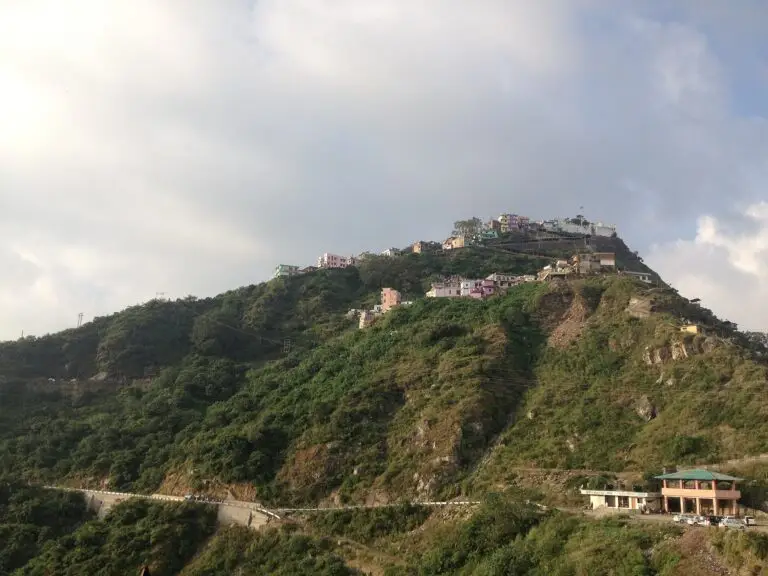
Yes, but it is a real mountain trek, not a short walk. Aadi Himani Chamunda is the original seat of the goddess, high in the Dhauladhar at a spot called Chandar Bhan, above Jia village. Sources give its height differently, roughly between 2,800 and 3,200 metres, so treat any single figure with care.
- Starting points: Jia village (near Nagrota Bagwan) or Jadrangal / Kardiana, the last place a vehicle can reach.
- Length: reports range from about 9 to 16 km one way depending on the route, and the climb usually takes 5 to 7 hours uphill.
- Difficulty: moderate to hard. Water is scarce on the upper half, so carry your own.
- Season: the district site says the temple is open from about 15 March to 15 November. Snow closes the route in winter.
- Stay: a basic sarai and a few tea stalls, as per the district site. Do not expect hotel-style rooms.
The old temple was badly damaged in 2014 (reports blame fire or lightning) and has been rebuilt with help from devotees and the trust.
Is there a ropeway to Himani Chamunda? No. A ropeway from the Chamunda area to Himani Chamunda has been talked about for many years. News reports say the company that got the project in 2015 was served a termination notice in 2022, and in September 2026 the Chief Minister told the Assembly the project had been pending for years without real progress. As of November 2026 no ropeway is running, so the only way up is on foot. Elderly pilgrims and anyone with heart or breathing problems should take darshan at the main temple below.
When is the best time to visit, and what are the main festivals?
The temple is open in all seasons. The busiest days are during the two Navratris:
- Chaitra Navratri (around March–April), which also marks the Hindu New Year puja on Chaitra Shukla Pratipada.
- Sharad (Ashwin) Navratri (around September–October), with a fair and langar from breakfast to dinner.
- Gupt Navratri in Shravan and Mahashivratri for the Nandikeshwar shrine. The trust also holds a group yajnopavit (sacred thread) ceremony around March–April.
Navratri brings big crowds and longer queues. If you are travelling with seniors and want a calmer darshan, weekdays outside festival weeks are easier. The monsoon months (July–August) bring landslides on Himachal roads, so keep a spare day in your plan.
How to reach Chamunda Devi Temple?
By air
The nearest airport is Kangra Airport at Gaggal (code DHM), which lies between Kangra town and Dharamshala. Taxis are available from the airport to the temple. Chandigarh airport is a bigger option with more flights, but it means a long road journey into Kangra valley.
By train
The nearest broad-gauge railhead is Pathankot. From there you can go by road, or by the narrow-gauge Kangra Valley toy train, which has a small station named Chamunda Marg on the Kangra–Palampur stretch. Please note that this line was shut for several years after the Chakki bridge collapse in 2022. News reports say limited services restarted in 2026, with only a few trains running and some days off. The toy train is slow and timings change, so check the current Indian Railways timetable before you rely on it.
By road
Chamunda is on the Dharamshala–Palampur road. As per the Kangra temple trust, it is about 14–15 km from Dharamshala, 17–19 km from Palampur, about 24 km from McLeodganj and about 30 km from Kangra town. HRTC buses and local taxis run on this road.
How to combine Chamunda with Brajeshwari, Jwala Ji, Chintpurni and Baijnath?
Coming from Punjab or Chandigarh, Chamunda is usually the last Devi darshan of the circuit. Families start at Naina Devi, move north to Chintpurni and then Jwala Ji, take darshan of Brajeshwari Devi in Kangra town, and reach Chamunda on the road towards Dharamshala and Palampur. Our guides to those temples cover their timings and distances.
If you want to add a Shiva darshan, the ancient Baijnath temple lies further along the same road beyond Palampur. Families with an extra half day often add it after Chamunda. McLeodganj and Dharamshala are close by if family members want a night in town.
Tips for senior citizens and families
- The main temple is close to the road with parking nearby, so it is one of the easier temples on the circuit. Some steps lead down to the cave shrine and the kund; take them slowly.
- Go early in the morning or after the midday bhog break to avoid the busiest hours, especially on Sundays.
- Kangra valley gets cold in the evening even in spring and autumn. Carry a shawl or light jacket; in winter (December–February) carry full woollens.
- Carry a basic medicine kit and your regular medicines. The trust lists drinking water, toilets and security staff at the complex.
- Keep footwear and bags simple. Shoes are left outside the darshan area.
- Do not attempt the Himani Chamunda trek with seniors who have heart, knee or breathing problems.
Related guide: Brajeshwari Devi temple, Kangra
How Yatra To Temples can help
Chamunda Devi is included in our Himachal Shakti Peeth and Devi Darshan Yatra, which starts and ends in Chandigarh and covers Naina Devi, Chintpurni, Jwala Ji, Baglamukhi, Brajeshwari Devi and Chamunda Devi, with stops at Anandpur Sahib and Kangra Fort. For a longer yatra, the Manimahesh Kailash Yatra with Seven Devi Darshan adds Mansa Devi, Chamba, Bharmour and the Manimahesh trek, starting in Chandigarh and ending in Amritsar, where most families also take darshan at the Golden Temple. Our yatra team plans it end to end. Price on request. If you want Baijnath or a different start point added, ask us through the contact page or write to shiva@yatratotemples.in.
Latest yatra updates
Frequently asked questions
Where exactly is Chamunda Devi Temple in Himachal?
It is at Padar village in Kangra district, on the bank of the Baner river, on the road between Dharamshala and Palampur. It is about 15 km from Dharamshala. Do not confuse it with the Chamunda Devi temple in Chamba town, which is a different temple.
What are the opening hours of Chamunda Devi temple?
As per the temple trust, it is usually open from 5 or 6 AM to 12 noon, closed for bhog from 12 to 1 PM, and open again till 9 PM in winter or 10 PM in summer. Morning aarti is around 8 AM and evening aarti around 7:10 PM. Timings can change on festivals, so confirm locally.
Is there an entry fee or VIP darshan at Chamunda Devi?
The trust’s page does not list any entry fee for general darshan, and langar is free. We did not find an official VIP darshan system listed for this temple. Please check with the temple office (01892-236034, as listed by the trust) for any current special puja arrangements.
Can elderly people visit Chamunda Devi easily?
Yes, the main temple is on the valley floor next to the road, so there is no long climb. There are some steps to the Shiva cave and the kund. The hill shrine of Himani Chamunda is a hard trek and is not suitable for most seniors.
Is the Himani Chamunda ropeway open?
No. A ropeway has been proposed for years, but news reports say work never actually began, and no ropeway is running as of November 2026. The only way up is a long trek from Jia or Jadrangal.
How far is Chamunda Devi from Jwala Ji and Brajeshwari?
As per the temple trust, Kangra town, home of Brajeshwari Devi, is about 30 km away. Jwala Ji is further south, and most families visit Jwala Ji, Brajeshwari and Chamunda on the same day or across two days by road. Exact travel time depends on traffic and road conditions.
Which is the nearest railway station to Chamunda Devi?
Pathankot is the nearest broad-gauge railhead. The Kangra Valley narrow-gauge line has a small station called Chamunda Marg, but services on this line were suspended for years and only partly restored in 2026, so check the current timetable first.
Sources
- Kangra Temples, Government of Himachal Pradesh – Shri Chamunda Ji Mata Temple
- District Kangra (NIC) – Shri Chamunda Nandikeshwar Dham
- Incredible India, Ministry of Tourism – Chamunda Devi Temple
Related guides
 Shakti Peeth List: Major Peeths in India and How to Visit
 Brajeshwari Devi Temple Kangra: Timings, History, Route
 Naina Devi Temple, Himachal: Ropeway, Timings & Route
More on Shakti Peeth: Brajeshwari Devi Temple Kangra · Naina Devi Temple, Himachal · Ambaji Temple Gujarat · Chintpurni Temple Guide · Kolhapur Mahalakshmi Temple · Jwala Ji Temple Guide · Tulja Bhavani Temple Tuljapur · Tarapith Temple Guide · Kanchi Kamakshi Amman Temple · Shakti Peeth yatra packages