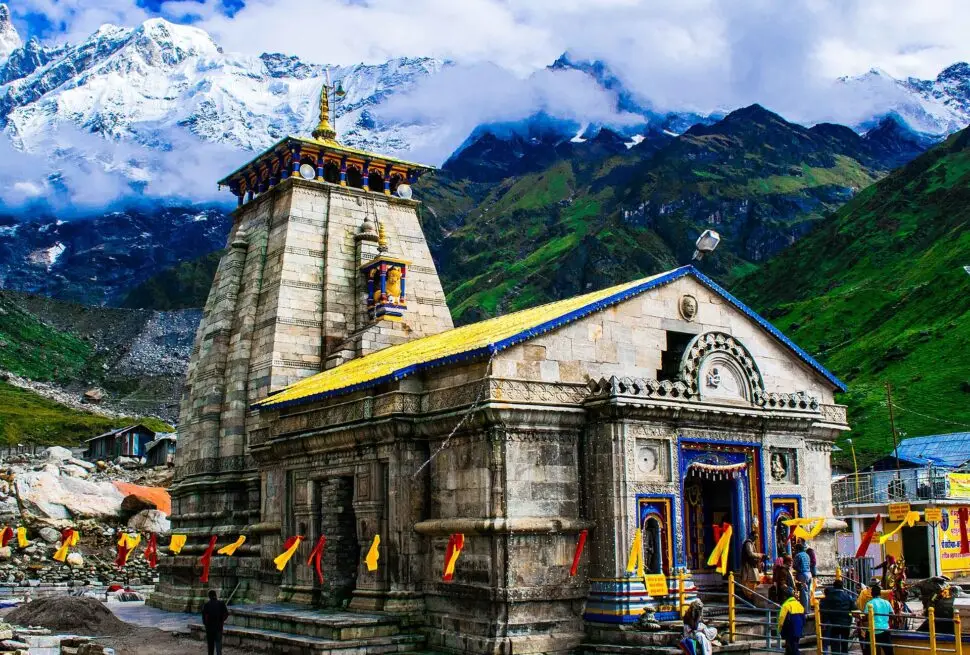
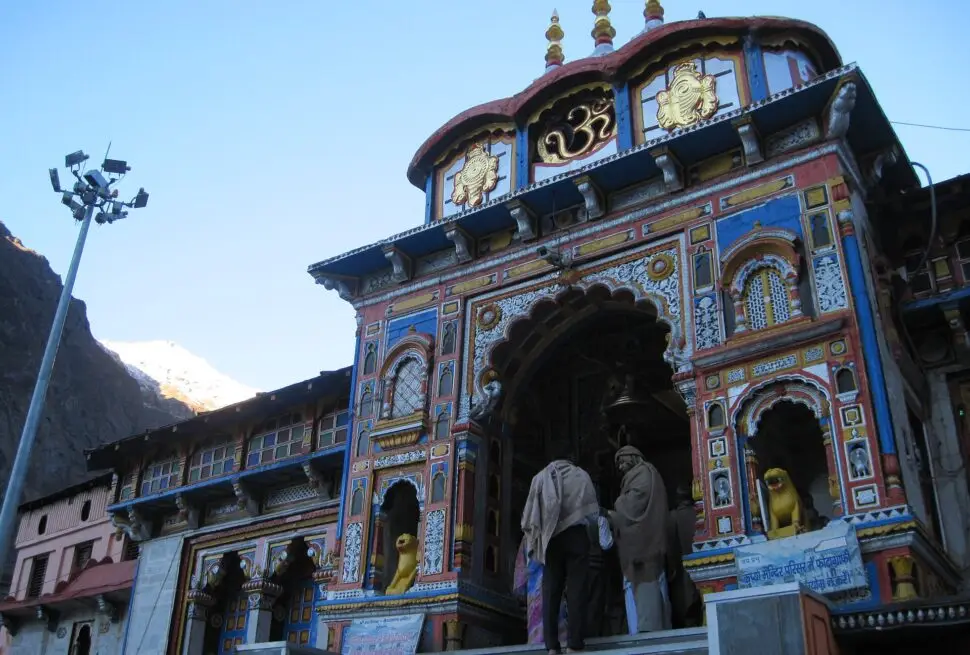
Quick answer: Badrinath sits at about 3,133 metres, so it is cold even in summer. Long-term modelled averages put May to September days at about 17 to 20°C and nights at about 7 to 11°C, while October nights fall close to 3°C. July and August are the wettest months. For 2026 the temple is open from 23 April to 16 November. For today’s conditions, check the IMD links below.
−8°C / 6°C
−10°C / 6°C
−9°C / 7°C
Forecast estimate for this spot, not a thermometer reading at the temple; actual weather can differ. Always follow official IMD alerts. Weather data: MET Norway (CC BY 4.0), updates automatically; tap Refresh for the latest.
Facts checked November 2026.
| Altitude | About 3,133 metres (Uttarakhand government sites; GMVN also lists 3,056 m) |
|---|---|
| District | Chamoli, Uttarakhand |
| Live forecast | IMD Dehradun district forecast and the IMD Chardham Yatra Sector Nowcast |
| Warmest months | June to August: days about 19 to 20°C, nights about 10 to 11°C (modelled estimates) |
| Wettest months | July and August (monsoon), with frequent landslide blocks on the highway |
| Driest season | October and November (fewest rainy days at nearby Jyotirmath): clear skies, cold nights |
| Temple open in 2026 | 23 April (6:15 am) to 16 November (9:37 pm, scheduled) |
| Winter darshan | Pandukeshwar and Jyotirmath, from late November to the spring opening |
Most families planning a Badrinath yatra ask two things: how cold will it be, and will the road be open? This guide answers both, month by month. Weather in the high Himalaya changes by the hour, so check the official links below on the day you travel.
This page is part of our Badrinath Yatra Guide. Planning the yatra? See our Char Dham and Badrinath yatra packages.
Where can I check Badrinath’s temperature today?
For the current temperature and the next few days’ forecast, use the India Meteorological Department (IMD). Its Dehradun Meteorological Centre covers all of Uttarakhand, including Chamoli district where Badrinath lies.
- IMD Dehradun home page: mausam.imd.gov.in/dehradun. It links to district forecasts, nowcasts and warnings.
- District weather forecast (PDF): Uttarakhand district forecast. A 7-day text forecast; Chamoli is named on days when rain or snow is expected. It gives no temperature figures.
- District-wise warnings: IMD warnings map for Uttarakhand. Check for yellow, orange or red alerts in Chamoli before you leave.
- Chardham Yatra Sector Nowcast: IMD Char Dham sector nowcast. Look for the Joshimath to Badrinath Hemkund Sahib sector, which shows rain warnings for the next few hours.
Check the district warning the evening before you drive from Rudraprayag or Joshimath, and again in the morning. If an orange or red alert is out for Chamoli, ask your driver and the local police about the road before you start.
Why is Badrinath so cold?
Badrinath is about 3,133 metres above sea level. Jyotirmath (Joshimath), the last big town before it, is about 1,875 to 1,890 metres. That height difference of about 1,200 metres means Badrinath is clearly colder than Jyotirmath on the same day. Even on a sunny June afternoon, the evening aarti can feel chilly, and nights can drop close to freezing in spring and autumn.
Badrinath temperature month by month
We could not find an official IMD monthly climate table for Badrinath town itself. So the table below gives two sets of figures. The first is modelled estimates for Badrinath from Climate-Data.org, as reproduced on Wikipedia (period not stated). The second is IMD’s 1971 to 2000 normals for Jyotirmath, a nearby IMD station that is lower and warmer, as reproduced on Wikipedia. Figures are rounded averages, not a promise for any single day.
| Month | Temple | Badrinath day / night (modelled) | Jyotirmath day / night (IMD 1971–2000) | Rainy days at Jyotirmath (IMD) | What to expect |
|---|---|---|---|---|---|
| January | Closed | 4°C / -5°C | 11°C / 2°C | About 4 | Deep winter, snow at Badrinath |
| February | Closed | 6°C / -5°C | 12°C / 3°C | About 6 | Cold, snow likely at Badrinath; winter darshan only |
| March | Closed | 10°C / 0°C | 17°C / 7°C | About 7 | Late snow possible; temple still closed |
| April | Opens 23 April (2026) | 15°C / 4°C | 21°C / 11°C | About 4 | Cold, snow still on slopes; light snow fell on 25 April 2026 |
| May | Open | 19°C / 7°C | 24°C / 14°C | About 6 | Pleasant days, cold nights; peak rush |
| June | Open | 20°C / 10°C | 25°C / 16°C | About 8 | Warmest month; pre-monsoon showers by month end |
| July | Open | 19°C / 11°C | 23°C / 17°C | About 15 | Heavy rain, landslides on the highway |
| August | Open | 19°C / 11°C | 23°C / 17°C | About 15 | Heavy rain, road blocks common |
| September | Open | 17°C / 8°C | 22°C / 15°C | About 9 | Rain eases in the second half; green valleys |
| October | Open | 14°C / 3°C | 22°C / 11°C | About 3 | Clear, dry and crisp; cold nights |
| November | Open till 16 Nov (2026) | 10°C / -1°C | 17°C / 7°C | About 1 | Freezing nights; early snow possible (snow on nearby peaks, 2 Nov 2026) |
| December | Closed | 7°C / -3°C | 13°C / 4°C | About 2 | Winter darshan at Pandukeshwar and Jyotirmath |
Two points stand out. First, the monsoon months of July and August get the most rain: IMD records about 15 rainy days each month at Jyotirmath. Second, October and November are the driest months of the temple season at Jyotirmath, with only one to three rainy days on average. So autumn skies are clear and nights are cold.
When are the Badrinath kapat open in 2026 and 2027?
The temple is open only for about six to seven months a year. For 2026:
- Opening: The kapat opened on Thursday, 23 April 2026, at 6:15 am. The date was announced on Basant Panchami, 23 January 2026, at the royal court of the Tehri Naresh in Narendranagar (ANI).
- Closing: The kapat are scheduled to close for winter on Monday, 16 November 2026, at 9:37 pm, as reported by Asianet Newsable on 20 October 2026.
- 2027 opening: Not announced yet. By tradition the date is fixed on Basant Panchami, which falls on Thursday, 11 February 2027 (Magha Shukla Panchami, per Drik Panchang data).
For timings, the Panch Puja days before closing and updates as soon as 2027 is announced, see our Badrinath opening and closing date page.
Which month is good for a Badrinath yatra?
- Late April to June: The most popular window. Days are pleasant, but nights are cold, and early season can still bring light snow. Crowds and traffic are heavy, so start early each day.
- July and August: The hardest months for road travel. The temple is open, but rain and landslides can hold vehicles for hours. Go only if you have spare days.
- September: Rain usually reduces in the second half. Valleys are green and crowds are thinner, but keep a buffer day.
- October to mid-November: Dry, clear and quiet, with sharp cold at night. Good for families who can handle the cold.
Is a Badrinath yatra in October a good idea?
For many families, yes. October is one of the driest months: IMD records only about three rainy days at Jyotirmath, and the modelled October rainfall at Badrinath is low compared with the monsoon. Skies are often clear, and the peaks around the temple are easy to see. Darshan queues are usually shorter than in May and June.
The trade-off is cold. Modelled October nights at Badrinath are around 3°C, and by early November they fall below freezing. On 2 November 2026, DD India reported fresh snowfall on the peaks around Badrinath and a sharp drop in temperature. So pack proper woollens, and keep elderly family members warm, especially for early morning darshan and the Tapt Kund bath.
Is the Badrinath road safe in the monsoon?
The Badrinath highway runs through steep, loose hillsides in Chamoli district. Heavy rain often brings debris down at known slide spots. For example, Amar Ujala reported that on 2 July 2026 debris at Pagalnala and Gulabkoti, between Pipalkoti and Helang, closed the highway for about 11.5 hours. About 8,000 pilgrims were held at checkpoints such as Pipalkoti, Jyotirmath and Helang until traffic resumed.
If you travel in July, August or early September:
- Keep one or two spare days in your plan.
- Check the IMD district warning for Chamoli each morning.
- Drive in daylight and stop where police or officials ask you to.
- Carry snacks, water, medicines and a power bank in case you are held up.
- Book rooms at Jyotirmath or Pipalkoti that can be extended if the road closes.
Can I have Badri Vishal darshan in winter?
Yes. After the kapat close, the utsav doli travels down the valley. Uddhav ji and Kuber ji stay at the Yogadhyan Badri temple in Pandukeshwar, and Adi Shankaracharya’s gaddi is kept at the Narsingh temple in Jyotirmath, where winter worship continues. Both places are lower and reachable in winter, though it is still very cold and snow can fall. Read our Badrinath winter darshan guide for details.
What should I pack for Badrinath, month by month?
| When | What to pack |
|---|---|
| April and May | Heavy jacket or down jacket, thermal inner wear, woollen cap, gloves, warm socks, sunglasses and sunscreen |
| June | Light jacket or fleece plus a sweater for evenings, cap, sunscreen, light rain jacket for late June |
| July to September | Good raincoat or poncho, umbrella, quick-dry clothes, waterproof shoes with grip, plastic bags for clothes and phones, a warm layer for nights |
| October | Down or heavy woollen jacket, thermals, cap, gloves, warm socks, lip balm and cold cream |
| November (till closing) and winter darshan | Full winter wear: thermals, down jacket, woollen cap, gloves, two pairs of woollen socks, shoes with grip for icy paths |
In every month, carry your regular medicines, a small first-aid kit, ID proof and your Char Dham registration. For a full list, see our Char Dham packing list. If Kedarnath is also part of your plan, its weather is different because you walk up to a higher shrine; read our Kedarnath weather guide.
How Yatra To Temples can help
If you want a by-road Badrinath yatra from Haridwar with Mana village and Jyotirmath included, see our Badri Vishal darshan yatra, or combine both dhams on the Do Dham yatra by road from Haridwar. For monsoon buffer days or winter darshan plans, ask us.
Latest yatra updates
Frequently asked questions
What is the temperature in Badrinath today?
We do not post live figures, because they change quickly. Check the IMD Dehradun district forecast and warnings for Chamoli and the IMD Char Dham sector nowcast. All are linked near the top of this guide.
Which is the coldest month at Badrinath?
January. Modelled averages put January days at about 4°C and nights at about -5°C. The temple is closed then, and winter darshan happens at Pandukeshwar and Jyotirmath.
Does it snow at Badrinath during the yatra season?
It can, mainly at the start and end of the season. Light snow fell at Badrinath on 25 April 2026, and fresh snow covered the nearby peaks on 2 November 2026. Snow in mid-summer is uncommon.
Is Badrinath open in December?
No. The kapat close in November (16 November in 2026) and reopen in late April or May. In winter you can have darshan at Pandukeshwar and the Narsingh temple in Jyotirmath.
Is it safe to visit Badrinath in July?
The temple is open, but July is the wettest month and landslides often block the highway for hours. If you go, keep spare days, check IMD warnings for Chamoli daily and follow local police advice.
How cold is Badrinath in October?
Modelled averages give October days of about 14°C and nights of about 3°C. It is usually dry and clear, but the cold builds quickly towards November, so carry heavy woollens.
Is Badrinath colder than Jyotirmath?
Yes. Badrinath is about 1,200 metres higher than Jyotirmath. IMD normals for Jyotirmath are several degrees warmer than the modelled Badrinath figures in every month.
When will the 2027 opening date be announced?
By tradition, on Basant Panchami at the Tehri royal court in Narendranagar. In 2027 Basant Panchami falls on 11 February. Our opening and closing date page will carry it once announced.
Sources
- India Meteorological Department – Meteorological Centre Dehradun
- Asianet Newsable – Badrinath Dham portals to close for winter season on November 16
- ANI – Badrinath Dham portals to reopen on April 23
- Wikipedia – Joshimath (climate table citing IMD Climatological Normals 1971–2000)
- Wikipedia – Badrinath (climate table from Climate-Data.org)
Related guides
 Badrinath Yatra Guide: Darshan, Tapt Kund and Mana
 Badrinath Temple History, Timings and Darshan Guide
 Valley of Flowers Trek Guide: Season, Permit, Route and Fees
More on Badrinath Yatra: Badrinath Temple History, Timings and Darshan Guide · Valley of Flowers Trek Guide · Badrinath Distance from Haridwar, Rishikesh, Delhi · Hemkund Sahib Opening and Closing Date · Badrinath Winter Darshan · Panch Badri Yatra Guide · Badrinath Opening and Closing Date · Mana Village Guide · Badrinath Yatra from Delhi · Char Dham and Badrinath yatra packages