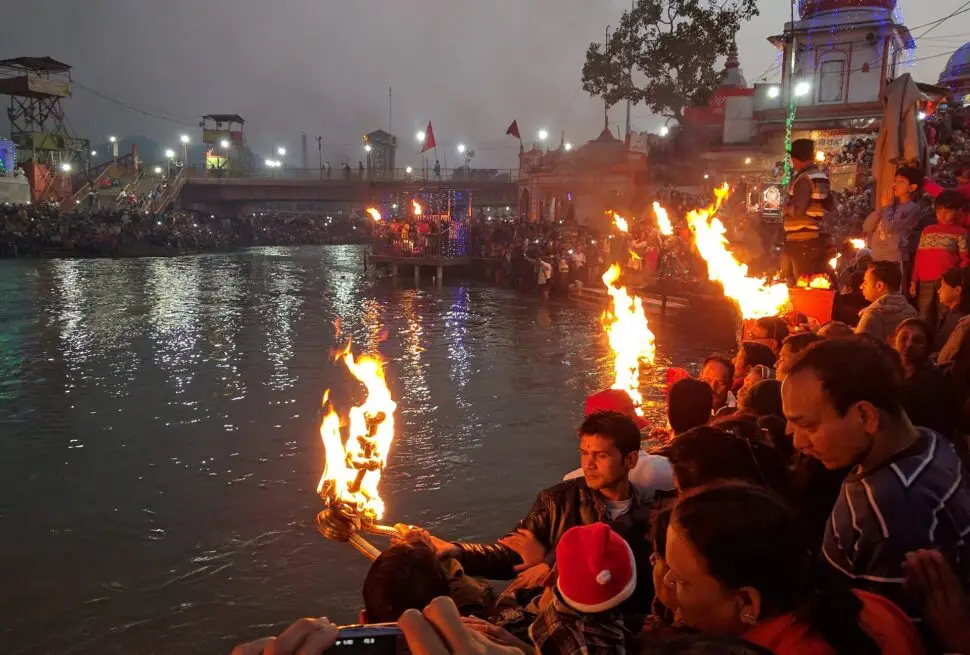
Quick answer: Triveni Sangam in Prayagraj is the meeting point of the Ganga, the Yamuna and the unseen Saraswati. For snan, families usually take a boat from the ghats near the fort, such as Saraswati Ghat, out to the confluence, and bathe from the boat or a roped area. Go early in the morning, agree the boat fare before boarding, and keep seniors and children close to the rope.
19°C / 28°C
16°C / 27°C
15°C / 26°C
Forecast estimate for this spot, not a thermometer reading at the temple; actual weather can differ. Always follow official IMD alerts. Weather data: MET Norway (CC BY 4.0), updates automatically; tap Refresh for the latest.
Updated for the 2027 yatra season (facts checked November 2026).
| What it is | Meeting point of the Ganga, the Yamuna and the unseen Saraswati |
|---|---|
| How to reach the confluence | By boat from ghats near the fort, such as Saraswati Ghat |
| Visiting hours | 5 AM to 7 PM (Incredible India) |
| Best time of day | Early morning: calmer river, thinner crowd |
| Main snan season | Magh Mela, every year in Magh, roughly January to February |
| Most crowded day | Mauni Amavasya, usually |
| Nearest railway station | Prayagraj Junction; Bade Hanuman ji temple roughly 7 km away |
| Nearest airport | Prayagraj Airport (IXD), Bamrauli |
A dip at the Sangam is, for many Hindu families, a lifelong wish. It is where pind daan is offered for ancestors, where children have their mundan, and where lakhs gather every Magh. This guide explains, in simple steps, how the snan works, how to keep elders safe, and which temples to see nearby.
This page is part of our Kashi Vishwanath Darshan guide. Planning the yatra? See our Kashi and Ayodhya yatra packages.
What is the Triveni Sangam in Prayagraj?
Triveni means “three rivers”. At Prayagraj, the Ganga coming from the north meets the Yamuna coming from the west. The third river, Saraswati, is believed to flow unseen beneath the earth and join them here. That is why the place is called Triveni Sangam, and why a snan here is counted among the most sacred in Hindu tradition.
The Ministry of Tourism’s Incredible India page on Triveni Sangam links the site to the drops of amrit that fell during the Samudra Manthan, and to the yajna performed here by Lord Brahma, from which the name Prayag is said to come. The Kumbh Mela is held here in its 12-year cycle, and the Magh Mela every year.
At the confluence, many pilgrims notice the Ganga looks lighter and the Yamuna darker. The meeting line shifts with the season and water level.
How do you reach the Sangam point for snan?
The actual confluence is in the middle of the river, so most people reach it by boat. There is also a large sandy bank on the Ganga side (the Sangam area used for the mela), where you can bathe at the edge, but the boat takes you closer to the true meeting point.
- Go to a ghat near the fort. Saraswati Ghat, on the Yamuna bank beside the Allahabad Fort (Akbar’s fort), is a common starting point. The Kila Ghat area below the fort is also used. Mankameshwar Mahadev temple is right next to Saraswati Ghat, so many families do darshan there first.
- Choose a boat and agree the fare first. Boat fares depend on the boat size, number of people and season, and they change on festival days. We do not list rates here because there is no current official rate list we could confirm. Agree the full amount, and whether it is per person or for the whole boat, before anyone steps in.
- Go out to the confluence. Boats tie up together near the meeting point, often against wooden platforms. Pilgrims bathe by stepping down from the boat into the water or into a roped area, holding the rope or the boat edge.
- Puja and return. Many families do a short sankalp or puja with a panda on the boat, offer flowers and diyas to the river, and fill a bottle of Sangam jal to take home.
During the Magh Mela and Kumbh, vehicles are often stopped far from the ghats and there is a lot of walking on sand. Boats may also be restricted on the biggest snan days, so follow police and mela announcements on the spot.
Is Sangam snan safe for seniors and children?
Yes, with care. Elders bathe here every day. The water can be deep and the current strong, so a few simple habits make a big difference:
- Bathe only within the rope or holding the boat. Do not swim out, even if the water looks calm.
- Go early in the morning. The river is usually calmer and the crowd thinner. Midday sun on the sand is tiring for seniors.
- One adult per child, and per senior. Hold hands while stepping between boats; the planks can be wet and slippery.
- Ask for life jackets. Check whether the boat has them and put one on children before the boat moves.
- Carry a towel, a full change of clothes and a plastic bag for wet clothes. In winter, add a shawl; January mornings in Prayagraj are cold.
- Keep valuables minimal. Leave jewellery at the hotel and keep phones in a zipped pouch with one family member who stays dry.
- Agree a meeting point on the ghat in case anyone gets separated, especially on mela days.
- In monsoon (July to September) the rivers rise sharply and boats may not reach the exact confluence. Senior pilgrims with heart or breathing problems should take a dip at the edge instead, or simply sprinkle water.
Which days are most auspicious for Sangam snan?
Snan at the Sangam is considered punya on any day, but certain days draw the largest crowds. Most of them fall during the Magh Mela, held every year in the Hindu month of Magh, roughly January to February.
| Snan day | Usual time of year | What to expect |
|---|---|---|
| Paush Purnima | Late December or January | The Magh Mela and Kalpvas usually begin around this day |
| Makar Sankranti | Mid-January | One of the main bathing days |
| Mauni Amavasya | January or February | Usually the most crowded day of the mela |
| Basant Panchami | January or February | Major snan day, dedicated to Saraswati |
| Maghi Purnima | February | Kalpvas usually ends around this day |
| Mahashivratri | February or March | Usually the last snan of the mela season |
Exact dates follow the Hindu calendar and change every year. The Uttar Pradesh government and the Magh Mela administration announce the official snan schedule before each mela. We have not found an official schedule for the 2027 Magh Mela yet, so please check the official announcement before booking travel. If you are bringing elders, consider an ordinary day in the mela period rather than Mauni Amavasya itself, when crowds are very heavy.
What rituals do pilgrims perform at the Sangam?
- Snan and sankalp: The holy dip, usually with a short sankalp in the family’s name and gotra, said by a panda (tirth purohit).
- Pind daan and tarpan: Prayag is one of the most important places for shraddha rites for ancestors. Pinds made of rice or barley flour, with til and kusha, are offered and then given to the river.
- Mundan: Many families bring young children for their first head-shaving ceremony here. Adults also shave their heads at the Sangam after the death of a family member or as part of a vow.
- Veni daan: A ritual in which married women offer a small part of their hair to the river, with the couple praying together for a long married life. Priests at the Sangam say it is done mainly by families from Maharashtra and South India.
- Deep daan and daan: Floating leaf-cup diyas and flowers, and giving daan to the needy or to brahmins.
Agree the dakshina for any ritual before it begins.
Which temples should you visit near the Sangam?
Bade Hanuman ji (Lete Hanuman ji) Mandir
This temple, about a kilometre from the Sangam near the fort, has a large reclining image of Hanuman ji set below ground level. In the monsoon, when the Ganga rises, river water enters the temple and partly covers the murti; devotees see this as Ganga Maa coming for Hanuman ji’s darshan. Most families visit here straight after snan.
Akshayvat and Patalpuri temple, inside the fort
The Akshayvat, the “undying banyan tree”, stands inside the Allahabad Fort, which is under the Army. For many years the public could not visit; it was opened to devotees in January 2019, at the time of the Kumbh. Today pilgrims reach it through a public corridor along with the underground Patalpuri temple, while the rest of the fort stays closed. Expect a security check and carry a photo ID. Entry arrangements can change, so confirm locally on the day.
Alopi Devi Mandir (Alop Shankari)
In Alopibagh, close to the Sangam, this much-loved temple of the Devi has no murti. Devotees worship a wooden doli (cradle). It is widely worshipped as a Shakti Peeth, though some traditions name the Lalita Devi temple in Prayagraj as the city’s Shakti Peeth, and many families visit both.
Mankameshwar Mahadev and Anand Bhawan
Mankameshwar Mahadev sits right beside Saraswati Ghat. Anand Bhawan, the Nehru family home that is now a museum, is optional and not a temple; it is usually closed on Mondays, so check before you go.
How many hours or days should you keep for Prayagraj?
As a rough guide for planning on ordinary days:
- Sangam snan only: plan the whole early morning. Reaching the ghat, choosing a boat, the ride, snan, puja and changing clothes take time, especially with elders.
- Snan plus the main temples (Bade Hanuman ji, Akshayvat, Alopi Devi, Mankameshwar): most families comfortably manage this in one full day if they start early.
- Pind daan, mundan or an evening aarti: keep extra time, and ideally a night’s stay, so the rituals are not rushed.
- Magh Mela or Kumbh days: everything takes far longer because of road closures and walking. Keep a spare day.
How do you reach Prayagraj?
By train: Prayagraj Junction is the main station, on major routes from Delhi, Kolkata, Mumbai and other cities. Bade Hanuman ji temple, next to the Sangam, is roughly 7 km from the junction. Smaller stations such as Prayagraj Sangam and Naini can also be convenient depending on where you stay.
By air: Prayagraj Airport (code IXD) is at Bamrauli on the western side of the city, with flights from several major cities. Varanasi and Lucknow airports are other options with more flights.
By road: Prayagraj is well connected by road to Varanasi, Ayodhya, Lucknow and Kanpur. Many families combine it with these cities in one yatra.
Can you combine Sangam snan with Kashi and Ayodhya?
Yes. Kashi, Prayagraj and Ayodhya are close to one another, and together they make one of the most popular dharmik yatra circuits in North India. A common order is Kashi Vishwanath darshan and Ganga aarti in Varanasi, then Sangam snan in Prayagraj, then Ram Lalla darshan in Ayodhya. For the Kashi part, see our guide on how many days to keep for Varanasi.
Related guide: Naimisharanya yatra guide
How Yatra To Temples can help
Our yatra team plans Prayagraj darshan end to end. On the one-day darshan, a local coordinator helps you hire a licensed boat and guides the snan and temple visits. Boat fare, dakshina and offerings are paid directly on the spot.
- Prayagraj darshan yatra: pickup at Prayagraj Junction, the airport or your hotel; Sangam boat snan, Bade Hanuman ji, Akshayvat and Patalpuri, Alopi Devi, Mankameshwar and Anand Bhawan, by private AC vehicle.
- Kashi Prayagraj Ayodhya tirth yatra: starts in Varanasi and ends in Ayodhya, with Sangam snan and puja, Bade Hanuman ji, Akshayvat and Alopi Devi on the Prayagraj stop.
- Pind daan and tarpan at the Sangam, done on your behalf: for families who cannot travel, a tirth purohit performs the rite in your name and gotra, and you receive a video or live link.
Want an evening Sangam aarti, a mundan, or a stay of more than one day? Ask us through the contact page or write to shiva@yatratotemples.in. Prices are on request.
Related guides: Also read the Gangasagar Mela guide. If you cannot come in person, see the Makar Sankranti Sangam snan sankalp done in your name. Also read Chitrakoot Dham yatra guide.
Latest yatra updates
Frequently asked questions
What is the best time of day for Sangam snan?
Early morning is best: the river is usually calmer, the crowd thinner, and seniors avoid the midday sun. Incredible India lists visiting hours of 5 AM to 7 PM, so plan to finish snan well before dark.
How much is the boat fare to the Sangam?
Fares vary by boat size, group size and season, and rise on mela days. We could not confirm a current official rate list, so agree the full fare, and whether it is per person or per boat, before boarding.
Can you take a dip at the Sangam without a boat?
Yes. On the sandy Sangam bank you can bathe at the river’s edge within marked areas. The boat simply takes you closer to the actual meeting point of the rivers.
Can women do snan at the Sangam?
Yes, women bathe at the Sangam every day. Changing enclosures are set up on mela days; on ordinary days facilities can be basic, so carry a large towel or a dry robe.
Is the Akshayvat open to the public?
Yes. Since 2019, devotees can visit the Akshayvat and Patalpuri temple through a public route inside the fort, which is an Army area. Carry photo ID and expect a security check; the rest of the fort remains closed.
Can pind daan at the Sangam be done if we cannot travel?
Yes. Some families ask a tirth purohit at the Sangam to perform pind daan and tarpan in their name and gotra. Our online pind daan service does this and shares a video or live link of the rite.
When are the 2027 Magh Mela snan dates?
The official schedule is announced by the Uttar Pradesh government and the Magh Mela administration before each mela. We had not found an official 2027 schedule when checking in November 2026, so please confirm the dates closer to travel.
Sources
- Incredible India, Ministry of Tourism – Triveni Sangam, Prayagraj
- Kumbh Mela, Government of Uttar Pradesh – Places to see
- India TV News – Army opens Fort area under its control for Kumbh visitors
Related guides
 Kashi Vishwanath Darshan: Timings, Sugam Darshan, Aarti
 Gaya Pind Daan: Process, Vedis, Pitru Paksha Dates
 Chitrakoot Dham Yatra Guide: Places to Visit, How to Reach
More on Kashi, Ayodhya and Prayagraj: Gaya Pind Daan · Chitrakoot Dham Yatra Guide · Naimisharanya Yatra Guide · Ram Mandir Darshan Timings, Aarti Passes · Dev Deepawali 2026 Varanasi · Mahamrityunjay Temple Varanasi · 10 Famous Temples in Varanasi · Ganga Aarti Varanasi Timings, Best Ghats and Boat Tips · How Many Days for Varanasi? Plans with Prayagraj, Ayodhya · Kashi and Ayodhya yatra packages