Quick answer: Ekambareswarar Temple in Kanchipuram, Tamil Nadu, is the Pancha Bhoota temple of Lord Shiva for the earth element (Prithvi linga). Incredible India, the Government of India tourism site, gives darshan hours as 6:00 am to 12:30 pm and 4:00 pm to 8:30 pm. It stands in the town centre, about 75 km from Chennai. Its sacred mango tree is linked to Goddess Parvati’s penance.
Facts checked November 2026.
| Main deity | Lord Shiva as Ekambareswarar (Ekambaranathar) |
|---|---|
| Goddess | Parvati as Elavarkuzhali |
| Element | Earth (Prithvi linga), one of the five Pancha Bhoota Sthalams |
| Darshan hours | 6:00 am – 12:30 pm and 4:00 pm – 8:30 pm (confirm locally) |
| Location | Town centre, Kanchipuram, Tamil Nadu |
| From Chennai | About 75 km by road |
| Main festival | Panguni Uthiram (Tamil month of Panguni, March–April) |
| Managed by | Tamil Nadu HR&CE Department |
Ekambareswarar Temple is one of the largest temples in Kanchipuram and one of the most important Shiva shrines in South India. The name means “Lord of the mango tree”, and the temple’s story begins with Goddess Parvati worshipping a linga of sand under a mango tree. This guide covers timings, the legend, what to see inside, how to reach, and the temples close by.
What are the Ekambareswarar Temple timings?
Incredible India, the official tourism site of the Government of India, gives 6:00 am to 12:30 pm and 4:00 pm to 8:30 pm. A temple listing whose data comes from the Tamil Nadu HR&CE Department gives the same hours, with the doors closed from about 1:00 pm to 4:00 pm, and Dinamalar’s temple page agrees. One news feature (South First, February 2024) gives shorter hours of 6 am to 11 am and 5 pm to 8 pm. Sources differ, so please confirm on the day, especially on festival days.
| Session | Time |
|---|---|
| Morning darshan | 6:00 am – 12:30 pm |
| Ushakala pooja | 6:30 am – 7:30 am |
| Uchikala pooja | 11:30 am – 12:30 pm |
| Temple closed | About 1:00 pm – 4:00 pm |
| Evening darshan | 4:00 pm – 8:30 pm |
| Ardhajama (last) pooja | From 8:30 pm |
Dinamalar’s page lists the temple office phone as +91-44-2722 2084. Crowds are larger on new moon, full moon and pradosha days.
Why is Ekambareswarar Temple famous?
The temple is one of the five Pancha Bhoota Sthalams, the Shiva temples that each stand for one of the five elements. Here Shiva is worshipped as the Prithvi linga, the earth linga. Temple tradition says Goddess Kamakshi (Parvati) shaped this linga out of sand, and that the mark of the Goddess embracing the Lord can still be seen on it.
It is also a Paadal Petra Sthalam. This means it is praised in the Tevaram hymns of the Tamil Shaiva saints Sambandar, Appar and Sundarar. Inside the temple complex is a small Vishnu shrine, Nilathingal Thundam Perumal, which is counted among the 108 Divya Desams. So both Shaiva and Vaishnava pilgrims visit.
What are the five Pancha Bhoota Sthalams?
| Element | Temple | Place |
|---|---|---|
| Earth (Prithvi) | Ekambareswarar | Kanchipuram, Tamil Nadu |
| Water (Jala) | Jambukeswarar | Thiruvanaikaval, near Tiruchirappalli, Tamil Nadu |
| Fire (Agni) | Annamalaiyar (Arunachaleswarar) | Tiruvannamalai, Tamil Nadu |
| Air (Vayu) | Srikalahasteeswara | Srikalahasti, Andhra Pradesh |
| Sky (Akasha) | Nataraja | Chidambaram, Tamil Nadu |
If you plan to cover more than one of these, our Tiruvannamalai temple guide explains the fire-element temple and the Girivalam walk.
Is Ekambareswarar Temple a Jyotirlinga?
No. Ekambareswarar is not one of the 12 Jyotirlingas. It is a Pancha Bhoota Sthalam, which is a different group of Shiva temples. People often mix the two up. To understand how the different Shiva groups and forms fit together, see our guide to Lord Shiva’s forms, names and temples.
What is the story of the Ekambareswarar mango tree?
The temple legend says Goddess Parvati did penance under a mango tree near the Vegavati river, worshipping the sand linga she had made. Tradition says the river flooded to test her. She held the linga close to protect it, and Shiva then appeared before her. He came to be called Ekambareswarar, the Lord of the mango tree. The marriage of Shiva and Parvati is still celebrated every year at the temple.
The tree is the temple’s sthala vriksham (sacred tree). It is popularly said to be about 3,500 years old. Dinamalar’s temple page says its four branches stand for the four Vedas and give mangoes of four different tastes. The Kancheepuram district website says childless couples who worship at the tree are believed to be blessed.
Is the old mango tree still alive?
Here sources do not fully agree, so we give what each says:
- A 2006 news report said the old tree had been dying and had started growing again after restoration work.
- A 2018 newspaper column said treatment began in December 2002, saplings were also cloned from the tree, and the tree began giving mangoes again in 2014.
- A more recent temple guide says the ancient trunk is preserved and a newer tree grows from the old root stock.
The “3,500 years” figure comes from tradition, not from a scientific test. When you visit, you can see the tree for yourself behind the main sanctum (the district website places it in the outer court) and ask the temple staff about its present state.
How tall is the Ekambareswarar Temple gopuram?
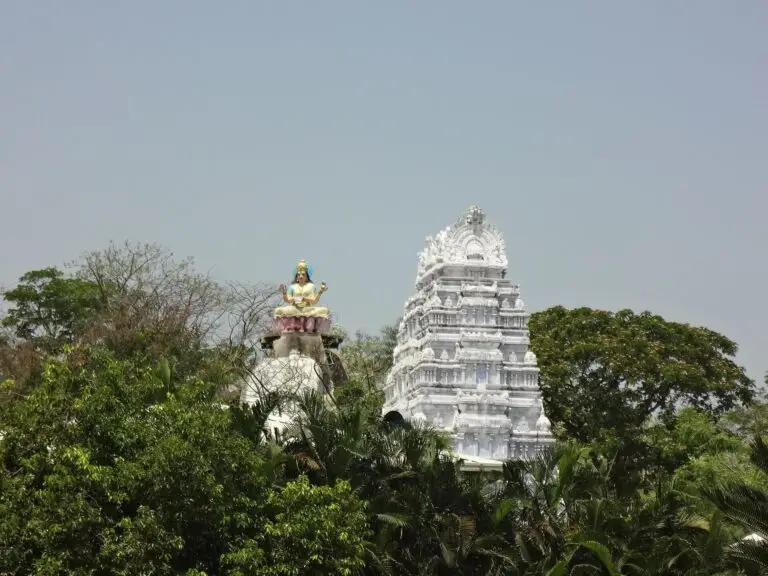
The southern rajagopuram has 11 storeys and is one of the tallest temple towers in South India. Its exact height is given differently by different sources. The Kancheepuram district website says 57 metres. Incredible India and other references give about 192 feet (about 58.5 metres), one temple guide says about 59 metres, and one visitor page says 172 feet. All agree it is among the tallest in the region. Historians credit the Vijayanagara king Krishnadevaraya with building this tower in the early 1500s.
The temple’s area is also given differently: about 23 to 25 acres in most references, and over 40 acres in one. Incredible India says the earliest shrine was a small one, possibly of wood, built around 600 CE by the Pallava king Mahendravarman. The Cholas later rebuilt it in stone, and the Vijayanagara rulers added the large towers and halls.
What can you see inside the temple?
- Aayiram Kaal Mandapam (Thousand-pillar hall): Built by the Vijayanagara kings, according to the district website. Take time to look at the carved pillars.
- Sacred mango tree: Behind the main sanctum, with a small shrine nearby.
- Sahasra lingam: A linga with 1,008 small lingas carved on it.
- 63 Nayanmars: Images of the 63 Tamil Shaiva saints are kept in the temple.
- Temple tanks: Sivaganga and Kamba Nadhi, both inside the temple walls.
- Nilathingal Thundam Perumal: The small Divya Desam shrine of Vishnu inside the complex.
Rules on photography and mobile phones can change, so follow the boards and the temple staff’s instructions.
When is the Panguni Uthiram festival at Ekambareswarar Temple?
The biggest festival is the Panguni Uthiram Brahmotsavam, held in the Tamil month of Panguni (March–April). Sources differ on its length: Dinamalar describes a 13-day festival, while Incredible India calls it a ten-day festival. Dinamalar mentions processions on a silver chariot, the silver Mavadi Sevai and a golden Nandi (Rishabha) vahanam. The HR&CE-based listing puts the Thirukalyanam, the marriage of Shiva and Parvati, on the 10th day.
The exact dates depend on the Tamil calendar and are announced by the temple each year. Other festivals include Maha Shivaratri, Karthigai Deepam, Navaratri and a three-day float festival (Theppam) in the Tamil month of Thai.
Is there a dress code at Ekambareswarar Temple?
We did not find a written dress code on an official page. Temple guides advise traditional, modest clothing: dhoti or trousers with an upper garment for men, and saree, half-saree or churidar for women, and one guide says men may be asked to wear a dhoti in some shrines. Our advice is to avoid shorts and sleeveless tops. Footwear is left outside, and the stone floors get hot in the afternoon, so a morning visit is easier on the feet.
Are there special darshan tickets or entry fees?
General darshan is usually free. Some travel sites list small charges for special entrance, archanas, cameras and parking, but we could not confirm these on an official HR&CE page today. Please check the current rates at the temple counter and pay only at official counters.
How do you reach Ekambareswarar Temple from Chennai?
| From | Distance | Notes |
|---|---|---|
| Chennai city | About 75 km | By road; buses and taxis run often |
| Chennai airport | About 60 km | Nearest airport |
| Kanchipuram railway station | About 1 km | Walking distance or a short auto ride |
| Kanchipuram bus stand | About 1.5–2 km | Some say it is close enough to walk |
| Arakkonam | About 30 km | Larger railway junction |
| Chengalpattu | About 35 km | Railway junction and road link |
By road: Kanchipuram is well linked to Chennai by government and private buses, and taxis are easy to find. By train: Kanchipuram has its own station with trains from Chennai side and Arakkonam. By air: Chennai International Airport is the nearest airport.
Which temples are near Ekambareswarar Temple?
- Kamakshi Amman Temple: About 1 km away in the heart of town (one travel site says 3 km, so walking routes vary). Read our Kanchi Kamakshi Amman temple guide.
- Kumara Kottam: A Murugan temple between Kamakshi Amman and Ekambareswarar.
- Kailasanathar Temple: Built in the 7th century by the Pallava king Rajasimha (Narasimhavarman II), says the district website; about 3 km from the bus stand.
- Varadaraja Perumal Temple: The great Vishnu temple in Vishnu Kanchi, about 4 km from the bus stand.
- Vaikuntha Perumal and Ulagalantha Perumal: Vaikuntha Perumal is an 8th-century Pallava temple and a Divya Desam; Ulagalantha Perumal honours Vishnu as Vamana.
For other major Shiva temples across the state, see our list of famous Shiva temples in Tamil Nadu.
What is the difference between Shiva Kanchi and Vishnu Kanchi?
Pilgrims often speak of Kanchipuram in two parts. Shiva Kanchi is the side of town with the big Shiva temples, including Ekambareswarar, along with Kamakshi Amman and Kailasanathar. Vishnu Kanchi, which the Kanchi Kamakoti Peetham’s visitor page also calls Chinna Kanchipuram, is home to the Varadaraja Perumal Temple and Ashtabhuja Perumal, about 4 km and 2 km from the bus stand. Many pilgrims spend one day on each side.
What is the best time to visit, and how much time do you need?
Kanchipuram is hot for much of the year, so our suggestion for families is the cooler winter months. In any season, go in the early morning when the stone floors are cool and queues are shorter. If you want to see the Panguni Uthiram processions, plan for March–April and expect large crowds.
Our estimate: allow about 1.5 to 2 hours to have darshan, walk the corridors and see the mango tree and the thousand-pillar hall. On festival or pradosha days, allow more. To see the main temples of Kanchipuram without rushing, plan at least one full day.
How Yatra To Temples can help
Our Kanchipuram Temple Town Darshan Yatra starts from Chennai, with pickup from Chennai airport or Kanchipuram railway station. The first day focuses on Vishnu Kanchi, and the second day includes Ekambaranathar with the Nilathingal Thundam shrine, Kamakshi Amman and more Divya Desams. The package page lists a hotel stay in Kanchipuram, pure vegetarian breakfast and dinner on set days, a private air-conditioned vehicle, and a yatra coordinator on call. Kailasanathar can be visited in the free last morning, and a few more temples can be added on request. Special darshan tickets and puja charges are not included. Call or WhatsApp us to check dates and ask about anything extra.
Latest yatra updates
Frequently asked questions
Which lingam is in Ekambareswarar Temple?
The main deity is the Prithvi linga, the earth linga. Tradition says Goddess Parvati made it from sand during her penance under the mango tree.
Who built Ekambareswarar Temple?
Incredible India says the earliest shrine was built around 600 CE by the Pallava king Mahendravarman. The Cholas rebuilt it in stone, and the Vijayanagara rulers added the tall southern gopuram and the thousand-pillar hall.
How old is Ekambareswarar Temple?
The temple was praised in Tevaram hymns from the 7th century, so worship here is at least that old. The present stone buildings were added over many centuries after that.
Is Ekambareswarar Temple and Kamakshi Temple the same?
No. They are two separate temples about a kilometre apart. Kamakshi Amman is the Goddess temple, while Ekambareswarar is the Shiva temple, and most pilgrims visit both on the same day.
Is Ekambareswarar Temple crowded?
Weekday mornings are usually calmer. Crowds are heavier on weekends, new moon, full moon and pradosha days, and during the Panguni festival.
How much time does darshan take at Ekambareswarar Temple?
On a normal day, plan about 1.5 to 2 hours to see the whole temple (our estimate). On festival days, queues can take much longer.
What is the goddess’s name at Ekambareswarar Temple?
Goddess Parvati is worshipped here as Elavarkuzhali. Kamakshi Amman, also a form of Parvati, has her own separate temple nearby.
Which district is Ekambareswarar Temple in?
It is in Kanchipuram town, in Kancheepuram district of Tamil Nadu. It is a different temple from the Ekambareswarar temple in Chennai city.
Sources
- Incredible India, Ministry of Tourism, Government of India – Ekambareswarar Temple (checked November 2026)
- Kancheepuram District Administration (kancheepuram.nic.in) – Places of Interest (checked November 2026)
- Hindu Temples in Tamil Nadu listing (data from Tamil Nadu HR&CE) – Arulmigu Ekambaranathar Temple, temple 1816 (checked November 2026)
- Dinamalar – Sri Ekambareswarar Temple, Kancheepuram (checked November 2026)
- South First – Sri Ekambareswarar Temple feature, February 2024 (checked November 2026)