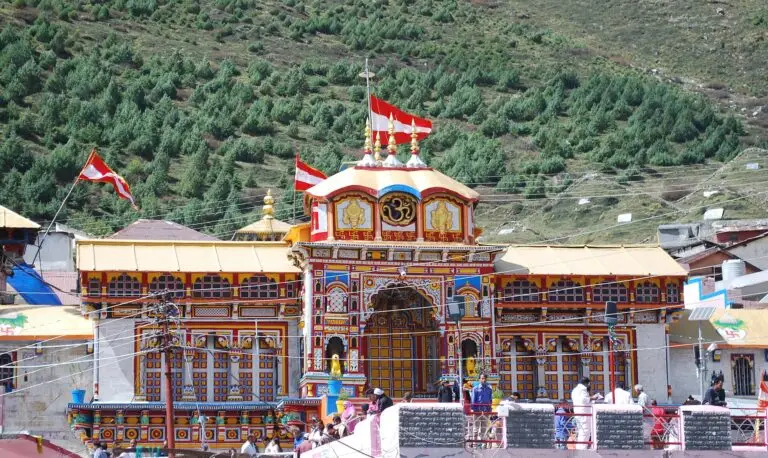
Quick answer: Badrinath temple in Chamoli district, Uttarakhand, is the Vishnu shrine of Badrinarayan, at about 3,133 metres. By tradition, Adi Shankaracharya found the black stone murti in the Alaknanda river and enshrined it. In season, published timings are about 4:30 am to 1 pm and 4:30 pm to 9 pm. Confirm locally, as times change on festival days.
−8°C / 5°C
−10°C / 6°C
−9°C / 7°C
Forecast estimate for this spot, not a thermometer reading at the temple; actual weather can differ. Always follow official IMD alerts. Weather data: MET Norway (CC BY 4.0), updates automatically; tap Refresh for the latest.
Facts checked November 2026.
| Deity | Lord Badrinarayan (Badri Vishal), a form of Vishnu, in a seated meditation pose |
|---|---|
| Murti | Black stone (often called shaligram), about one metre tall per BKTC, with conch and chakra |
| Location | Badrinath, Chamoli district, Uttarakhand, on the Alaknanda river between the Nar and Narayan ranges |
| Height | About 3,133 metres (about 10,280 feet) |
| Re-established by | Adi Shankaracharya (8th or 9th century, by tradition) |
| Head priest | The Rawal, a Namboodiri Brahmin from Kerala; Amarnath Namboodiri since July 2024 |
| Managed by | Shri Badarinath Kedarnath Temple Committee (BKTC) |
| Season | About six months, from late April or May to October or November |
Badrinath is one of the Char Dham of Uttarakhand and one of the 108 Divya Desams of Lord Vishnu, according to Incredible India. This guide explains the history and legends, the murti, the Rawal, the temple timings, how to book a puja on the official website, and the sacred places around the temple.
This page is part of our Badrinath Yatra Guide. Planning the yatra? See our Char Dham and Badrinath yatra packages.
What is the history of Badrinath temple?
The temple committee (BKTC) tells two connected stories. In the first, Lord Vishnu took birth as the twin sages Nar and Narayan, sons of Dharma, to end the cruelty of the demon Sahasrakavacha. They did long tapasya (penance) in this valley. The two mountain ranges on either side of the temple carry their names even today.
In the second story, Vishnu sat in deep meditation here, open to cold, rain and snow. Goddess Lakshmi took the form of a badri (wild plum or jujube) tree to shelter him. The place came to be called Badri, and the Lord became Badrinarayan, the “Narayan of the badri tree”. BKTC also notes that the area had a different name in each yuga: Muktiprada in Satyuga, Yoga Siddhida in Tretayuga, Vishala in Dwaparyuga and Badrikashram in Kaliyuga.
Another story often told is that Narad Muni did penance here on one foot for a very long time. Devotees believe that in the six winter months, when the kapat (doors) are closed, Narad himself worships the Lord, and the Akhand Jyoti keeps burning inside.
How did Adi Shankaracharya find the murti?
BKTC says Adi Shankaracharya found the black stone murti of Badrinarayan in the Alaknanda river. By tradition, it was taken out of Narad Kund, the pool in the river below Narad Shila rock, near the hot spring of Tapt Kund. He first placed it in a cave near Tapt Kund. BKTC records that a king of Garhwal later moved the murti to its present temple in the sixteenth century.
Sources differ on the exact century of Shankaracharya’s visit. The Uttarakhand yatra portal says the 8th century, while some historians place him in the early 9th. Incredible India notes the temple has been renovated after avalanches and landslides.
What does the Badrinath murti look like?
The main murti is Lord Badrinarayan carved in black stone, often described as shaligram. He sits in padmasana, the lotus meditation pose, and holds a conch and a chakra in two raised hands. BKTC describes the murti as one metre high. The canopy over the garbhagriha is covered with a sheet of gold, and BKTC puts the temple building at about 50 feet tall.
Around the Lord in the garbhagriha (sanctum) you can see Kuber, Garuda, Narad, Uddhav, and Nar and Narayan. The complex also has a silver Ganesh, a statue of Adi Shankaracharya and a shrine of Mata Lakshmi. BKTC lists about 15 murtis in the whole complex.
Who is the Rawal of Badrinath?
The chief priest of Badrinath is called the Rawal. By a long tradition, the Rawal is a Namboodiri Brahmin from Kerala, at the other end of India. BKTC says the Rawals come from the Malabar region and are believed to follow the line of Adi Shankaracharya. Only the Rawal performs the main daily puja in the sanctum.
The present Rawal is Amarnath Namboodiri. PTI reported in July 2024 that BKTC accepted the voluntary retirement of the earlier Rawal, Ishwari Prasad Namboodiri, on health grounds, and gave charge to Naib (deputy) Rawal Amarnath Namboodiri. This is the usual path: a priest first serves as Naib Rawal before he becomes Rawal. In May 2024, PTI also reported that the Tehri royal family performed a pattabhishek (anointing) ceremony for the Rawal.
How high is Badrinath?
Badrinath is about 3,133 metres (about 10,280 feet) above sea level, according to Incredible India, the Garhwal division website and the Uttarakhand yatra portal. Some older books round it to about 3,100 metres. At this height, nights are cold even in June, and some people feel breathless. If you have heart, lung or blood pressure problems, speak to your doctor before the yatra.
What are the Badrinath temple timings?
BKTC has not published daily timings on its website, the state yatra portal says timings “will be announced soon”, and the Garhwal division page gives only season dates. The figures below come from Incredible India, the Government of India’s official travel site. Please treat them as a guide and confirm locally, because times shift on festival days, on the kapat opening and closing days, and on days of special processions.
| Session | Published timing (confirm locally) | What happens |
|---|---|---|
| Morning | About 4:30 am to 1:00 pm | Morning pujas, then general darshan |
| Afternoon break | About 1:00 pm to 4:30 pm | Doors closed |
| Evening | About 4:30 pm to 9:00 pm | General darshan, evening pujas and Shayan aarti at night |
Timings can change without notice. For example, on the day of the Mata Murti fair in September 2024, Amar Ujala reported that the temple doors would stay closed until 3 pm while Uddhav ji went to Mana. For opening and closing dates of the season, see our Badrinath opening and closing date page.
How do I book a puja or darshan at Badrinath online?
Use only the official temple committee website, badrinath-kedarnath.gov.in. There is no general entry ticket for darshan. What you book online are pujas, paths, aarti and bhog offerings. The steps are simple:
- Open badrinath-kedarnath.gov.in and register. BKTC says prior registration is mandatory, and you need an Indian mobile number.
- Choose Badrinath, then the puja you want. The site shows the earliest available date and the number of seats left.
- Pick your date, enter the names of the family members, and complete payment on the site.
- Keep the receipt on your phone and carry the same photo ID you used.
When we checked in November, the site showed no Badrinath seats because the season was ending. Please be careful of websites or agents promising “VIP darshan” tickets; book pujas only on the official site. Your yatra registration is a separate step on the Uttarakhand portal. Our Char Dham registration guide explains it.
What is Tapt Kund?
Tapt Kund is a natural hot spring just below the temple, on the bank of the Alaknanda. Incredible India says the water stays at about 55°C all year. Many pilgrims take a bath here before going up for darshan. Close by is Narad Kund, the spot linked with the recovery of the murti, and Surya Kund, another hot spring. Enter the water slowly, and keep children and elders near the edge.
What other sacred places are near the temple?
These places are a short walk or drive away. Distances are from BKTC’s website and the state yatra portal, and are approximate.
| Place | Distance from temple | Why devotees go |
|---|---|---|
| Tapt Kund and Narad Kund | Just below the temple | Holy bath before darshan; place linked with the murti |
| Brahma Kapal | About 0.5 km | Pind daan and tarpan for ancestors, on the Alaknanda bank |
| Charan Paduka | About 2.5 km | Rock believed to carry Lord Vishnu’s footprints |
| Mata Murti temple | About 3 km | Shrine of the mother of Nar and Narayan |
| Mana village | About 4 to 4.4 km (by road) | Vyas Gufa, Ganesh Gufa, Bhim Pul and the Saraswati river |
Brahma Kapal
Brahma Kapal is a flat rock platform on the Alaknanda, a few minutes’ walk from the temple, where families perform pind daan and tarpan for their ancestors. The rituals are done by local teerth purohits (pilgrimage priests).
Mata Murti temple
Mata Murti is honoured as the mother of Nar and Narayan. Incredible India says she prayed for Vishnu to be born as her son, and he came as the twin sages. Her temple stands beside the Alaknanda, towards Mana. Incredible India says a fair is held each September on Shravan Dwadashi. Amar Ujala reported that on this day Uddhav ji, the friend of Lord Badrinath, goes from the temple to Mana to meet her.
Urvashi temple at Bamni
The Urvashi temple stands in Bamni village, close to Badrinath, and is dedicated to Goddess Urvashi. Local priests say it is counted among the 108 Shaktipeeths, and some legends link the goddess with Sati. People of Bamni and Pandukeshwar worship here regularly. In April 2025, Bhuwan Chandra Uniyal, a former religious officer of Badrinath Dham, told reporters that the temple is part of local sacred tradition.
Mana village
Mana sits about 4 km beyond the temple near the India–Tibet border. It has Vyas Gufa, where Ved Vyas is believed to have composed the Mahabharata, along with Ganesh Gufa and Bhim Pul over the Saraswati. Read our Mana village guide before you go.
Where is Lord Badrinath worshipped in winter?
When the kapat close in October or November, the utsav murtis go down the valley. All India Radio reported that at the 2025 closing, Uddhav ji and Kuber ji would stay at Pandukeshwar for the winter, and Adi Shankaracharya’s gaddi would reach the Narsingh temple in Jyotirmath (Joshimath). Devotees can have winter darshan at these two places. Our Badrinath winter darshan guide has the details.
For roads, stay and weather, read the full Badrinath yatra guide.
How Yatra To Temples can help
If you want darshan with time for Tapt Kund, Brahma Kapal and Mana, see our Badri Vishal darshan yatra. For a puja booking, a pind daan priest or other help, ask us.
Latest yatra updates
Frequently asked questions
Who built Badrinath temple?
By tradition, Adi Shankaracharya re-established Badrinath in the 8th or 9th century after he found the murti in the Alaknanda. BKTC says a Garhwal king moved the murti to the present temple in the sixteenth century. The building has been repaired many times since.
Which god is worshipped at Badrinath?
Lord Badrinarayan, a form of Vishnu, is worshipped here in a black stone murti in a meditation pose. Lakshmi, Ganesh, Kuber, Uddhav, Narad, Garuda and Nar-Narayan are also worshipped in the complex.
Why is the Badrinath priest from Kerala?
By long tradition, the Rawal (chief priest) is a Namboodiri Brahmin from Kerala, believed to follow the line of Adi Shankaracharya. Only the Rawal performs the main puja in the sanctum. The present Rawal is Amarnath Namboodiri.
Is there a ticket for Badrinath darshan?
There is no general entry ticket for darshan. Special pujas, paths, aarti and bhog can be booked on the official BKTC website, badrinath-kedarnath.gov.in, after registering with an Indian mobile number.
What time of day is calmer for darshan?
Many families find early morning, soon after the temple opens, and late evening calmer than the middle of the day. Times can change, so confirm locally the evening before.
How hot is the water of Tapt Kund?
Incredible India says Tapt Kund stays at about 55°C through the year. Step in slowly and do not stay in too long, especially elders and people with heart or blood pressure problems.
Where is the Urvashi temple near Badrinath?
The Urvashi temple is in Bamni village near Badrinath. It is an old temple of Goddess Urvashi, which local priests say is counted among the 108 Shaktipeeths.
Is Badrinath temple open in winter?
No. The temple closes for about six months, usually in October or November. Worship continues at Pandukeshwar and at the Narsingh temple in Jyotirmath during winter.
Sources
- Shri Badarinath Kedarnath Temple Committee – Shri Badrinath
- Shri Badarinath Kedarnath Temple Committee – Official website and puja booking
- Incredible India – Badrinath Temple
- All India Radio News – Portals of Badrinath Dham closed for winter
- PTI via NewsDrum – Resignation of Badrinath Dham’s chief priest accepted
Related guides
 Badrinath Yatra Guide: Darshan, Tapt Kund and ManaBadrinath Distance from Haridwar, Rishikesh, Delhi: Km ChartBadrinath Weather and Temperature: Month by Month Guide
More on Badrinath Yatra: Badrinath Distance from Haridwar, Rishikesh, Delhi · Badrinath Weather and Temperature · Badrinath Winter Darshan · Valley of Flowers Trek Guide · Badrinath Opening and Closing Date · Hemkund Sahib Opening and Closing Date · Badrinath Yatra from Delhi · Panch Badri Yatra Guide · Mana Village Guide · Char Dham and Badrinath yatra packages